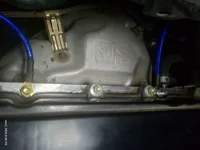
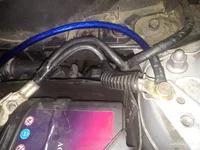
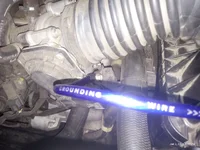
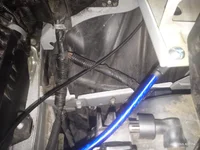
Nice install!
Those should be good ground connections. If you own or have access to a clamp on amp meter it will confirm your install. This is a handy item to have around the house...
https://www.amazon.com (commissions earned)
I clamp the meter around an installed ground, start the car, turn on the headlights, HVAC fan on high and read the meter. If it's around 1 amp, then that's not the right connection point.
On a NA your Butt Dyno will give will tell a small difference. Like 8 HP, like a CAI but better. Turbos make so much low end torque it's more difficult to feel 8 HP gains. I had log before and after runs on "my" test course on CC. Then mess around graphing the results. More like a labor of love.
Here is an example of a steady state test using % engine load. Less engine load to move the car over the same stretch of road at the same speed = better efficiency or more power.
At point 3, this is when the car has to pull hard to go up a steep hill at 50 MPH. You can see how the grounded car, red line, engine load didn't increase nearly as much as without grounds.
In hind sight, it would have been more dramatic if I had run my tests from 750 RPM to 2000 RPM at partial throttle. To do this is more difficult. Looking at the WOT dyno graph of a Gen 3 Hemi, it make most of power at low RPM. So in stop and go traffic, a grounded car will either be more peppy or more FE. It ALL depends on the operator.
This is NOT a home run modification. More like a single. It has a payback in 1 to 2 tanks of fuel and keep saving mile after mile, year after year. I put these on and forget about them. If it save the owner about $200 per year, that's almost a nice dinner for two.
View attachment 380197
On below dyno graph the top line is the grounded engine at WOT. I made most of the gains at a low and mid range RPM. We ran this test many times and got the same results. We rented different chassis dynos to see if it was how this make and model calculated HP. Same results on other dynos. Interesting, HP or FE gains is about the same across the board on all makes and models, 8 to 9 HP.
Average HP needs to be ignored because the dyno operator didn't go to WOT the same on each test nor end the test at the same rpm. He could have only shown from 3000 to 5,500 RPM.
From 3,000 to 5,500 RPM shows how a nice increase from just from some cables! It would have been interesting if the test had started a 2000 RPM. Problem with going to WOT on a dyno at low RPM it puts a tremendous strain on the engine. My guess, at 2000 RPM the gain is more than 9 HP.
Top two "flat" graphs are torque, the other graphs are HP.
View attachment 380198


 While searching for grounding kits, the product reviews reveal positive feedback when installed on a wide range of vehicles. Nothing backed by scientific analysis though, just simple user observations.