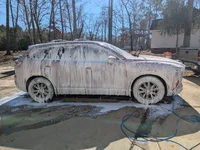
If spraying the exterior of the body panels doesn't do jack to remove the salt, then we'll get the same result underneath.
... Not to mention the fact that those underbody jets are useless.
At bare minimum, hosing-down of a surface results in less crud on that surface. Salt is tenacious, though, and its chemical corrosive action cannot be wholly halted without fighting it chemically.
On that point, no anti-salt chemicals being in those touchless carwash undercarriage sprays, I'll grant you. But it's better than "jack" (doing nothing at all).
In my case, I've got the undercarriage treated, such that occasional spraying-off of surfaces does far better than for most people whose vehicles don't have any undercoating. Doesn't address the bolts and nuts, no. That's where a salt-neutralizing spray does help.
But that's a real trick to accomplish during single-digit (or lower) winter temperatures, where
anything through a hose freezes solid the moment it bathes a car's surfaces with what little freezing water is flowing.
In the next life, I'll build a good-sized heated garage with a lift, such that little tasks such as this can be done in the air, salt-neutralizing sprays and whatnot used to good effect, with scrubbing/agitation of surfaces (with brushes) to extend that. But short of that sort of setup, the regular touchless spraying and occasional undercarriage hand spraying of salt-neutralizer is about all we've got available. Is what it is.
Regular hosing-down of an undercarriage is far better than leaving the crud there to fester and speed the "cancer". Isn't perfect. But without good alternatives there isn't much other choice. I'm all ears, for single-digit and sub-zero temps, if someone has another solution that bests the above. I'm sure many in the "snow belt" would appreciate knowing, too.