
You are using an out of date browser. It may not display this or other websites correctly.
You should upgrade or use an alternative browser.
You should upgrade or use an alternative browser.
Grounding Cylinder Head Test Results (2024 CX-5 Turbo)
- Thread starter AL Cx5
- Start date
-
- Tags
- cylinder head ground wire

AL Cx5
2024 CX-5 Prem Turbo Tuned Lowered Forged Wheels
I was off topic and was hoping to learn more about our engine sensors. When do they start losing calibration before a CEL comes on from an automotive engineer.While browsing broadly to learn, I came across grounding kits that are meant to replace factory wires, for the same reasons you replaced functioning sensors. So far the only factory grounding wire that I found to be stand-alone, is the cylinder-to-chassis on the passenger side. It looks thin next to my 6 gauge battery cable. I assume thicker is better. Are there any other factory grounding wires that are easy to replace? Most others seem to diverge from bundle of wires. Thank you!
Honestly, I have done more than a cursory look for OEM grounds. I see them but don't pay much attention to them. My goal was to do the tried and true extra grounding for better FE. The car had less than 100 miles on it when I installed the grounds, started this post. The community was more critical than interested. I moved on.
After grounding my attention went to improving handling, picking wheels and tires. The suspension install was more involved that other cars I've worked on but got it done.
Next was installing a slight performance tune and we enjoyed the car. We are finishing the next upgraded tune. It's almost a hot rod. Needs another 100 HP and it would be a handful. LOL Honestly, the new power level is just right. Drives like stock until we turn on Sport mode. Then it gets fairly aggressive. FE with this tune is even better than stock or the first tune. The first tune was more FE than stock too.
Last edited:

- :
- 2017 CX3 AWD
Do they age though?Ground wires don't go bad like sensors. They are not wear items.
Do they age though?
Ground wires' copper can corrode (though high-grade wiring that's tinned and wrapped helps). The ring ends can corrode. But I wouldn't think any more so than existing ground wires. I'd call it a "for the life of the car" type part. Unless seeing severe salt-laden air (near coastlines) or if getting wet frequently (ie, hosing down the engine bay), perhaps.
My own 2016 CX-5 doesn't have but light surface discoloration (hardly enough to call it "corrosion) on "ring" ends here and there. Several of the various bolt and screw heads have far more.
AL Cx5
2024 CX-5 Prem Turbo Tuned Lowered Forged Wheels
X2 on age. If you live in an area that puts chemicals on the roads in the winter, ground connectors can corrod.Ground wires' copper can corrode (though high-grade wiring that's tinned and wrapped helps). The ring ends can corrode. But I wouldn't think any more so than existing ground wires. I'd call it a "for the life of the car" type part. Unless seeing severe salt-laden air (near coastlines) or if getting wet frequently (ie, hosing down the engine bay), perhaps.
Using experience gained from a 20 year old truck. Battery power and grounds corroded under the insulation. I'll always pay extra for an agm battery for this and other reasons.
Guys with older truck is who live up north have way more electrical issues as the grounds and wiring harness corroded. Hard starts, poor FE and electrical gremlins. We always recommend to newbies to clean the ground connectors or better yet replace with a HD set.
I make my ground cables from tinned, fine strand 4 gauge wire, marine grade with water proof shrink wrap and tinned connectors. These should last longer than the car. But audio wire and copper connectors will work fine. Others made the grounds from welding leads.
The finer the strands the better it will ground is my rule.
- :
- 2018 CX 5 Touring AWD
The chassis steel and welds are not great conductors. Thick copper wire has much lower resistance. When connected to well chosen grounding points there can be a benefit.
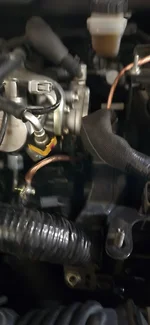
A obvious grounding point on my 2018 can be found by removing the plastic cover on the engine revealing a factory grounding point near but not on the the throttle body.
A obvious grounding point on my 2018 can be found by removing the plastic cover on the engine revealing a factory grounding point near but not on the the throttle body.
- :
- 2017 CX3 AWD
Thank you ALL especially AL! Being in a warm climate, the wires are probably OK. I have put away the extra cables for now and will focus on driving. 
This thread on grounding caught my interest and after reading a few pages at a time to the end, I decided to put all of that aside and just see what readings I got on a few cables on my (stock, untouched) 2014 as installed from the factory. Didn't loosen any bolts or clean any connections. Just started it up and hung on the clamp meter. Engine was still at high idle as this only took a few minutes.
The engine was cold ~40*F and high idle as normal. Headlights on low beam and blower fan on high (heat setting so no A/C compressor load.
1) Thin ground wire on passenger side from fender bracket to bracket on side of head --- 15A
2) Thinner, short cable from battery negative post to fender --- 25A
3) Battery negative cable ---- 27A
Don't know if this is of much significance to this discussion but thought to put it out there for any possibly enlightening comments. Haven't decided to add any additional heavier cables as that would be a warmer weather decision/project, but just may at some point remove the bolts and clean up the surfaces and attach some star washers and seal the connections for corrosion protection.
The engine was cold ~40*F and high idle as normal. Headlights on low beam and blower fan on high (heat setting so no A/C compressor load.
1) Thin ground wire on passenger side from fender bracket to bracket on side of head --- 15A
2) Thinner, short cable from battery negative post to fender --- 25A
3) Battery negative cable ---- 27A
Don't know if this is of much significance to this discussion but thought to put it out there for any possibly enlightening comments. Haven't decided to add any additional heavier cables as that would be a warmer weather decision/project, but just may at some point remove the bolts and clean up the surfaces and attach some star washers and seal the connections for corrosion protection.
See my results above.Something must be wrong here. After all the engine block *IS* already grounded (even if not perfectly). I cannot believe there are 5+amps flowing through these grounds.
ETA : just to make sure I didn't misread the decimal point location on any reading, I just now did a recheck. It's dark and colder. Same conditions as above. All respective readings higher this time.
1) 18.9A
2) 32.5A
3) 33.9A
Time for dinner. G'bye.
Last edited:
- :
- 2017 CX3 AWD
Been driving around with 3 extra cables and still haven't obtained the readings yet. It looks like I am more muscles than brains. 
- :
- 2018 CX 5 Touring AWD

N7turbo
2023 CX-5 2.5T ... 2024 MX-5 RF GT
I just learned how Mazda manages battery charging voltage.
It seems like a lot of engineering work for fuel economy when they could have just added more grounding cables.
Copilot:
Mazda absolutely does adjust charging voltage based on battery condition, but it does it in a very Mazda‑specific, fuel‑efficiency‑driven way that’s different from the “smart charging” systems used by some other brands.
Here’s the clear breakdown of how it works.
There’s no Hall‑effect sensor on the negative terminal, and no IBS (Intelligent Battery Sensor).
Instead, Mazda uses a charging strategy controlled by the PCM that adjusts alternator output based on:
Mazda intentionally keeps voltage low to reduce parasitic drag on the engine and improve fuel economy.
This is why your CX‑5 often shows ~13.7V even with a brand‑new battery.
You’ll see this when:
During decel or engine braking, the PCM increases alternator load because it’s “free” energy.
You may see:
This is why voltage dips into the 13.2–13.6V range during normal driving.
Mazda infers battery condition from:
It seems like a lot of engineering work for fuel economy when they could have just added more grounding cables.
Copilot:
Mazda absolutely does adjust charging voltage based on battery condition, but it does it in a very Mazda‑specific, fuel‑efficiency‑driven way that’s different from the “smart charging” systems used by some other brands.
Here’s the clear breakdown of how it works.
Mazda modulates charging voltage, but not by directly measuring battery SOC
Mazda does not use a dedicated battery current sensor (like Honda, BMW, Ford, etc.).There’s no Hall‑effect sensor on the negative terminal, and no IBS (Intelligent Battery Sensor).
Instead, Mazda uses a charging strategy controlled by the PCM that adjusts alternator output based on:
- Engine load
- Electrical load (lights, HVAC, defroster, etc.)
- Battery temperature
- Alternator temperature
- RPM
- Acceleration vs. deceleration
- Estimated battery condition (inferred, not directly measured)
How Mazda’s charging system actually behaves
Mazda’s alternator is ECU‑controlled and uses a “smart-ish” strategy:1. Low charging voltage during normal cruising
Typical: 13.4–13.8VMazda intentionally keeps voltage low to reduce parasitic drag on the engine and improve fuel economy.
This is why your CX‑5 often shows ~13.7V even with a brand‑new battery.
2. Higher voltage during cold starts or heavy electrical load
Typical: 14.2–14.8VYou’ll see this when:
- The battery is cold
- The battery was recently discharged
- You’re idling with lots of accessories on
- The alternator is cool
- The PCM detects high electrical demand
3. Voltage spikes during deceleration
Mazda uses a mild form of regenerative charging (not hybrid-level regen).During decel or engine braking, the PCM increases alternator load because it’s “free” energy.
You may see:
- 14.5–14.8V during downhill or throttle‑off moments
4. Voltage reduction during acceleration
To reduce engine load, Mazda drops alternator output when you’re accelerating.This is why voltage dips into the 13.2–13.6V range during normal driving.
Does Mazda measure battery health directly?
Not in the way AGM‑optimized systems do.Mazda infers battery condition from:
- How quickly voltage rebounds after starting
- How much voltage sags under load
- Temperature inputs
- Alternator duty cycle history
What this means for AGM batteries
Mazda’s system will charge an AGM perfectly safely, but:- It may not fully charge an AGM to 100% SOC
- It may keep the AGM at 80–90% most of the time
- Occasional topping off with a smart charger is beneficial
In short
Mazda does adjust charging voltage dynamically, but:- It does not directly measure battery SOC
- It uses engine load, electrical load, and temperature to decide charging voltage
- It prioritizes fuel economy over perfect battery charging
- It’s compatible with AGM batteries, just not optimized for them

AL Cx5
2024 CX-5 Prem Turbo Tuned Lowered Forged Wheels
Omg! What a convoluted charging system. I might have passed on a Mazda had I knownI just learned how Mazda manages battery charging voltage.
It seems like a lot of engineering work for fuel economy when they could have just added more grounding cables.
Copilot:
Mazda absolutely does adjust charging voltage based on battery condition, but it does it in a very Mazda‑specific, fuel‑efficiency‑driven way that’s different from the “smart charging” systems used by some other brands.
Here’s the clear breakdown of how it works.
Mazda modulates charging voltage, but not by directly measuring battery SOC
Mazda does not use a dedicated battery current sensor (like Honda, BMW, Ford, etc.).
There’s no Hall‑effect sensor on the negative terminal, and no IBS (Intelligent Battery Sensor).
Instead, Mazda uses a charging strategy controlled by the PCM that adjusts alternator output based on:
So the car does vary charging voltage, but it’s based on system conditions, not a precise measurement of battery state of charge.
- Engine load
- Electrical load (lights, HVAC, defroster, etc.)
- Battery temperature
- Alternator temperature
- RPM
- Acceleration vs. deceleration
- Estimated battery condition (inferred, not directly measured)
How Mazda’s charging system actually behaves
Mazda’s alternator is ECU‑controlled and uses a “smart-ish” strategy:
1. Low charging voltage during normal cruising
Typical: 13.4–13.8V
Mazda intentionally keeps voltage low to reduce parasitic drag on the engine and improve fuel economy.
This is why your CX‑5 often shows ~13.7V even with a brand‑new battery.
2. Higher voltage during cold starts or heavy electrical load
Typical: 14.2–14.8V
You’ll see this when:
- The battery is cold
- The battery was recently discharged
- You’re idling with lots of accessories on
- The alternator is cool
- The PCM detects high electrical demand
3. Voltage spikes during deceleration
Mazda uses a mild form of regenerative charging (not hybrid-level regen).
During decel or engine braking, the PCM increases alternator load because it’s “free” energy.
You may see:
- 14.5–14.8V during downhill or throttle‑off moments
4. Voltage reduction during acceleration
To reduce engine load, Mazda drops alternator output when you’re accelerating.
This is why voltage dips into the 13.2–13.6V range during normal driving.
Does Mazda measure battery health directly?
Not in the way AGM‑optimized systems do.
Mazda infers battery condition from:
This is a “soft” estimation, not a true SOC measurement.
- How quickly voltage rebounds after starting
- How much voltage sags under load
- Temperature inputs
- Alternator duty cycle history
What this means for AGM batteries
Mazda’s system will charge an AGM perfectly safely, but:
This is why many Mazda owners run AGMs with no issues, but the battery doesn’t always reach its ideal absorption voltage.
- It may not fully charge an AGM to 100% SOC
- It may keep the AGM at 80–90% most of the time
- Occasional topping off with a smart charger is beneficial
In short
Mazda does adjust charging voltage dynamically, but:
- It does not directly measure battery SOC
- It uses engine load, electrical load, and temperature to decide charging voltage
- It prioritizes fuel economy over perfect battery charging
- It’s compatible with AGM batteries, just not optimized for them

Has anyone calculated who much HP an alternator uses? Well I made a swipe at a dumb 20 year old alternator. AI rule of thumb 1 HP for every 23 to 24 amps.
- :
- '23 CX-5 CE
I would rather have Mazda's solution than the Nissan VCCS on my truck.Omg! What a convoluted charging system. I might have passed on a Mazda had I known
Has anyone calculated who much HP an alternator uses? Well I made a swipe at a dumb 20 year old alternator. AI rule of thumb 1 HP for every 23 to 24 amps.

Mazdiod2
CX-5 Sport 2016.5 6MT
This might be why keeping my battery on a battery tender helps so much, the battery is chronically undercharged.Mazda modulates charging voltage, but not by directly measuring battery SOC
Mazda does not use a dedicated battery current sensor (like Honda, BMW, Ford, etc.).
There’s no Hall‑effect sensor on the negative terminal, and no IBS (Intelligent Battery Sensor).
Instead, Mazda uses a charging strategy controlled by the PCM that adjusts alternator output based on:
In short
Mazda does adjust charging voltage dynamically, but:
- It does not directly measure battery SOC
- It uses engine load, electrical load, and temperature to decide charging voltage
- It prioritizes fuel economy over perfect battery charging
- It’s compatible with AGM batteries, just not optimized for them
AL Cx5
2024 CX-5 Prem Turbo Tuned Lowered Forged Wheels
I'd rather walk than drive a Nissan. I know I'll get there....I would rather have Mazda's solution than the Nissan VCCS on my truck.


AL Cx5
2024 CX-5 Prem Turbo Tuned Lowered Forged Wheels
AI suggests a CX 5 alternator load per the following.
Estimate, 60 amps to run the system pretty maxed out or a 2.5 HP penalty. On a NA that would be 1.33% drain at 187 HP. So why did Mazda build such a complex system to save a fraction of a HP??
MAZDA could have improved a few other areas. Better grounding has picked up 6 to 8 HP from my testing. Or a better air filter box on the turbos, I haven't tested a NA air filter box. And so forth...
AI gibberish
Typical Amp Draw of Components
The precise total amperage can vary based on the specific year and trim level (e.g., LED vs. HID headlights, blower speed), but here are general estimates:
Estimate, 60 amps to run the system pretty maxed out or a 2.5 HP penalty. On a NA that would be 1.33% drain at 187 HP. So why did Mazda build such a complex system to save a fraction of a HP??
MAZDA could have improved a few other areas. Better grounding has picked up 6 to 8 HP from my testing. Or a better air filter box on the turbos, I haven't tested a NA air filter box. And so forth...
AI gibberish
Typical Amp Draw of Components
The precise total amperage can vary based on the specific year and trim level (e.g., LED vs. HID headlights, blower speed), but here are general estimates:
- Air Conditioning (A/C) Compressor Clutch: Draws about 2.5 to 5 amps. The blower motor will also draw power depending on its speed setting (2 to 30 amps).
- Headlights:
- High Energy Discharge (HID): 7 to 8 amps once warm (12-14 amps initially).
- LED: Less than 1 amp per bulb.
- Other Running Lights and Small Bulbs: Small incandescent bulbs draw around 0.3 to 0.4 amps each.
- Other Essential Systems: The engine control unit, fuel pump, electric power steering (2-40 amps), and other electronics are all running
New Posts and Comments

- Replies
- 17
- Views
- 7K

- Replies
- 1
- Views
- 71


- Replies
- 8
- Views
- 725


- Replies
- 4
- Views
- 476