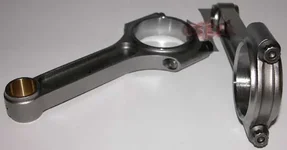
conrods

:
2001 323 Astina SP20 (P5)
just asking if i've got this right because i've seen a few conflicting answers on the net.

for NA high rpm you want h beams because they have good tension strength (stretching), for FI you want i beams because they have good compression strength.

have i got that right?

and this is right too : h-beam on the left, i beam on the right? (again, conflicting internet information)

Connec10.jpg
 
I beams are definately on the right...H beams on the left...thats how I was told at least...I know a lot of people at school confuse it, and the professors say it is because of civil and structural engineers terming "I beams" for bridges...which look like H beam connecting rods...if you know what I mean...

as far as compression and intertial strength...that depends mostly on the material used, and the process by which they were made...4340 forged steel is extremely strong at both, and i beams tend to be a little lighter, and a little weaker with that application...but forged aluminum can sometimes go either way depending on the forging process...(cut from billet, or cut then forged, etc.)...I beams are the easier of the two to cast into a mold, forge, then clean up...H beams are usually machined out of billet from what I remember (this was a automotive elective I took over 3 years ago, this stuff could be wrong...haha)...which is how I made my rods...but can also be machined and shaped, then forged again, etc...it is difficult to say which is stronger for which type of application in every situation though...
 
Last edited:
cool. yeah i just read a few areas saying that h-beams are more suited to high rpm NA because they are basically dont stretch. from what i've read too, they are usually around the same weight most of the time

ok, so since you went with the h-beams, if i was going for a 10k rpm monster with a rod ratio of 1.7+ you'd go with the h-beams?
 
I'd like to see a definate answer to this question also.

From what I've seen and read, you want the lightest possible rod for high rpm applications. and as you know, the lightest rod is never the strongest rod. I doubt the rod type has much to do with it, I was under the impression that I & H where based on the level of the build. I for mild builds, and H for racing conditions. I always assumed H beams where superior to I beams in every way except for weight.

I think the real question is what material H beam rods to use for high rpm. Aluminum or titanium, forged or billet etc.
 
Last edited:
H-Beams=Heavy (usually)

I Beams=Light (usually)

Use according to your needs and HP level. RPM plays very little difference in which one you need until you get into reducing weight.

As an example the Ford GT, and the '03/'04 Cobra used H-Beam rods. They are high HP FI, but although they are multi-valve engines, they are not high rpm (6500rpm limits). Total strength meant more than weight and revability to Ford's engineers in these applications.

My high-rpm stroker (342) uses 520 gram ultra-lightweight I-beams rated at 850+hp.
 

Attachments

  • 4340ULI_2.webp
    4340ULI_2.webp
    7.4 KB · Views: 110
Last edited:
good post...that is what I was attempting to get at...it is "easier" to make H-beams stronger than I beams...but certain I beams can also be way stronger than certian H beams...it totally depends on the manufacturing process...

here is a brief break down to my understanding...

billet cutting is cheaper, yet lacks the post cut forging process's metal grain patterns for added strength...

cut-then-forge is the strongest available...and usually the most expensive...

titanium alloy has the highest strength to mass ratio, but plan on spending roughly 2k+ for a set...

billet aluminum is the cheapest lightweight material to use, and can save considerable weight over cast steel...But strength can and will be an issue depending on how high it is revving...

4340 forged steel rods are the easiest way to get bullet proof rods, but they are not extremely light compared to the other metals available....they are usually the most affordable rods too...they are not ideal for our NA applications, but they will still handle the revs without a problem...their weight will come down to how tough the crank is...which is yet to be discovered as far as high revs...
 
I believe that the metal used and way in which they're manufactured are more important than the type of rod itself. For NA, you want a light, strong rod. I also agree that an H-beam would give you good tensile strength, but it could be significantly heavier than just a high quality, forged I-beam. Personally, I'm going to lighten, balance, shot-peen and polish my stock forged rods, which should allow them to handle anything I can throw at them.
 
A high revving engine doesnt always mean you need strong ass rods. If the compression stays the same then your rods should be able to withstand it. Now i also firmly believe that the I type rods even thought they're lighter you will be better off with the stock setup but possibly with the new mam thing you're (deadhorse) (cheers)
 
uh....no...MPS and piston acceleration will stretch connecting rods just as fast compressive forces will destroy them...

we are talking about connecting rods that can withstand 8000+rpm in an FS...that is a huge order...
 
then you do car about rod strength, very much. basically the ultimate setup for you would be an I beam for weight made out of one of exotic metals metioned by installshield with the best billet/forging process for that metal.

since we've gotten most of the tech out of the way, now its a question of how much your willing to spend, as installshield has hinted it could be quite alot.
 
yeah I am totally confused...rod strength is directly correlated with both compression and inertial load...if a certain metal grain pattern (the forging process creates this) is good at handling a positive load (compression), it has to be good at handling a negative load (intertial "stretching")...thats the metal itself, and it almost always works that way...Certain designs can be better for one over the other, but the metal more or less doesn't care...

With internal parts...it almost entirely is based on the certain materials strength to mass ratio...that is all that really matters...Titanium completely rules this...
 
ghettobubba2001 said:
nonono i meant if you bought I rods you should be fine with them. im disorderd atm

no problem sir, I as well...I guess I am not understanding what was being asked or commented on...
 
ghettobubba2001 said:
A high revving engine doesnt always mean you need strong ass rods. If the compression stays the same then your rods should be able to withstand it. Now i also firmly believe that the I type rods even thought they're lighter you will be better off with the stock setup but possibly with the new mam thing you're (deadhorse) (cheers)

Actually, RPM is worse on rods than boost. Accelerative forces at high RPM can produce thousands of G's. A 500g piston will act like 1500kg, albiet for fractions of a second, but you need a very strong rod to handle that.
 
I personally have witnessed with my own eyes a piston & remnants of a rod come through a hood after a transmission failure at tree and a tragic overrev.

the difference is compression doesn't increase exponentially, there is always a "set" boost pressure, compression ratio, or nitrous shot. with RPM however, the stress on rods increases linearly & exponentially.

so while the rod may be able to handle 550HP @ 6000RPM with 30psi of boost without worry. 200HP @ 9500+ RPM on a N/A motor could cause that same rod to stretch causing the piston to hit the valves (very common), or worse complete rod failure.
 
Back