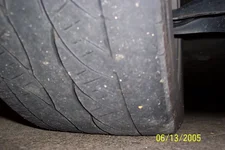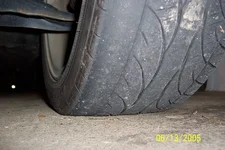
I've been searching for threads explaining uneven tire wear, it's causes, and how to fix it. I have been suffering from severe inside (front) tire wear. I hope the following helps anyone figure out their tire wear problems.
First, the sources of information:
http://www.michelinman.com/care/tip3.html
http://www.artsautomotive.com/thealignmentstory.htm
Both of these websites agree on tire wear and alignment causes.
Second, the problems:
If you look at your tires and see that the inside edge is wearing quickly, the alignment is probably off. This is a combination of camber and toe settings. The outside edge is the same but the camber and toe settings are the opposite.
Low tire pressure usually shows wear on the outside edge. This is a result of the tire "rolling" over itself (to the outside) during cornering. High tire pressure increases alignment problems by making the tire contact surface smaller (smaller tire = more wear). On a perfectly aligned car too high of tire pressure will wear out the center of the tire.
Third, the reasons:
Inside tire wear is caused by a combination of negative camber (the tires put more pressure on the insides, usually caused by lowering the vehicle) and negative toe (the front of the tires are further apart than the rear).
Lets look at negative toe for a second. If the top of this page is the front of the car, the wheels look like: \ / The inside edge is being pushed forward. If the camber is negative, more pressure is on the inside of the tire.
And now positive toe: The wheels look like / \ and the outside edge is being pushed forward. If the camber is positive, more pressure is on the outside of the tire.
What if I have toe out and positive camber? From what I've seen the inside edge of the outside tire when cornering (right tire when turning right) will experience heavy wear. I noticed that that tire will squeal first. The outside edge of the other tire will be under load as well. This setting probably won't solve any tire wear issues.
And what about toe in and negative camber? I have no experience with this setting, but with extreme negative camber the inside edge of the outside tire (left tire when turning right) will experience heavy wear. The inside edge of the other tire will probably be under load but this really depends on how negative your camber is.
Fourth, Solutions:
On the protege the first thing you can do is to rotate the strut mounts. This is explained on page 2 of Section 02-11 in the factory service manual. You can adjust the front camber by 30 minutes. Do a quick check by using a level on top of the tire. Remember to compare both sides in case you're not on flat ground.
The second thing to do is adjust the toe. I found that a half hour is ample to make minor toe adjustments by turning the tie rods. This is explained very well on the same page as above. If your steering angle is perfect (steering wheel is level when going straight) adjust both sides equally. Use your eyes to see which direction the wheel is moving (look at the lock nut and remember that you're adjusting the rear end of the knuckle).
If these adjustments don't solve your problems you'll need to get camber bolts or plates. The toe is always adjustable but the camber is limited with the stock setup.
Fifth, the disclaimer.
If you screw up your tires or get in a wreck because your alignment is screwed up, I never told you to change it. Always get your alignment periodically checked by an alignment shop, because they have very precise tools that you can't replicate.
Hope this helps someone. I'm going downstairs to fix the toe-out I added yesterday and dial in some toe-in. I have my front struts in the "B" setting, which is 30 minutes more positive camber, same caster, as stock. Hopefully this will solve my inner tire wear so I don't have to spend $500 on new tires next month, but maybe next year (* optimistic).
First, the sources of information:
http://www.michelinman.com/care/tip3.html
http://www.artsautomotive.com/thealignmentstory.htm
Both of these websites agree on tire wear and alignment causes.
Second, the problems:
If you look at your tires and see that the inside edge is wearing quickly, the alignment is probably off. This is a combination of camber and toe settings. The outside edge is the same but the camber and toe settings are the opposite.
Low tire pressure usually shows wear on the outside edge. This is a result of the tire "rolling" over itself (to the outside) during cornering. High tire pressure increases alignment problems by making the tire contact surface smaller (smaller tire = more wear). On a perfectly aligned car too high of tire pressure will wear out the center of the tire.
Third, the reasons:
Inside tire wear is caused by a combination of negative camber (the tires put more pressure on the insides, usually caused by lowering the vehicle) and negative toe (the front of the tires are further apart than the rear).
Lets look at negative toe for a second. If the top of this page is the front of the car, the wheels look like: \ / The inside edge is being pushed forward. If the camber is negative, more pressure is on the inside of the tire.
And now positive toe: The wheels look like / \ and the outside edge is being pushed forward. If the camber is positive, more pressure is on the outside of the tire.
What if I have toe out and positive camber? From what I've seen the inside edge of the outside tire when cornering (right tire when turning right) will experience heavy wear. I noticed that that tire will squeal first. The outside edge of the other tire will be under load as well. This setting probably won't solve any tire wear issues.
And what about toe in and negative camber? I have no experience with this setting, but with extreme negative camber the inside edge of the outside tire (left tire when turning right) will experience heavy wear. The inside edge of the other tire will probably be under load but this really depends on how negative your camber is.
Fourth, Solutions:
On the protege the first thing you can do is to rotate the strut mounts. This is explained on page 2 of Section 02-11 in the factory service manual. You can adjust the front camber by 30 minutes. Do a quick check by using a level on top of the tire. Remember to compare both sides in case you're not on flat ground.
The second thing to do is adjust the toe. I found that a half hour is ample to make minor toe adjustments by turning the tie rods. This is explained very well on the same page as above. If your steering angle is perfect (steering wheel is level when going straight) adjust both sides equally. Use your eyes to see which direction the wheel is moving (look at the lock nut and remember that you're adjusting the rear end of the knuckle).
If these adjustments don't solve your problems you'll need to get camber bolts or plates. The toe is always adjustable but the camber is limited with the stock setup.
Fifth, the disclaimer.
If you screw up your tires or get in a wreck because your alignment is screwed up, I never told you to change it. Always get your alignment periodically checked by an alignment shop, because they have very precise tools that you can't replicate.
Hope this helps someone. I'm going downstairs to fix the toe-out I added yesterday and dial in some toe-in. I have my front struts in the "B" setting, which is 30 minutes more positive camber, same caster, as stock. Hopefully this will solve my inner tire wear so I don't have to spend $500 on new tires next month, but maybe next year (* optimistic).