Question about tire repair

On my weekend trips there are two sections in the hills with frequent high wind warning. In recent months, I could feel getting pushed more than before. Will find out in a few weeks if the new tires grip the road better.

There had been a few storms this year but I didn't feel unsteady in the downpours.
 
The Uniroyal TigerPaws are still working for me. 😂 I moved my well established Oleander plants to my weekend spot and kept them in the tires for two weeks. Now that I have secured a ground-breaking pitch fork, I can put the plants in the ground.

The tires were previously partially buried in the dirt for a wild-west look. I am obsessed with the set in the original "From Dusk 'til Dawn."

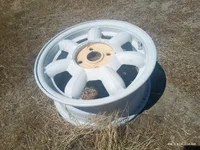
Between May 18 and December 19 when I owned a 1993 MX-5, I bought a set of old rims as backup. They were just as beatup as the set on my NA, so I painted them daisy-style during the pandemic. I must have done a good job because the paint looks intact after sitting in the sun for 3 years.
 

Attachments

  • IMG_20260509_085206685.webp
    IMG_20260509_085206685.webp
    395.1 KB · Views: 10
  • IMG_20260509_113409628.webp
    IMG_20260509_113409628.webp
    340.8 KB · Views: 9
Last edited:
Patch with the plug is the proper and best way to go. Cracking indicates dry rot, get rid of them. Also, when you buy a "new" set of tires check the date code. Anything older than 7 years is a no-go.
What I heard was plug and the patch work together to seal the steel belts of the tire from both sides.
 
What I heard was plug and the patch work together to seal the steel belts of the tire from both sides.
That's what I found online as well. If plugging is $45, patching+plugging must be even more. 😬

Have you heard that once a tire is patched/plugged in two places, it has to be replaced after a third puncture?
 
The ride is definitely not as loud or bumpy. Again there was a gusty wind warning over the Pacheco Pass but I didn't feel unstable at all. Maybe it wasn't quite gusty.

However, my mpg is down to what Mazda intended at 31. 😭 It was in the upper 30s for a very long time. Will check the tire pressure but I saw the tech read from the door jamb sticker before he inflated them.

The oil/filter was changed last Monday and I didn't notice such a drop during the week. 🤦
 
What I heard was plug and the patch work together to seal the steel belts of the tire from both sides.
Yes, in case you don't know it's actually one piece, plug attached to the patch. The bead has to be broken and you have to scuff the inside of the tire with a tool so there's better adhesion.
 
At that age they're not safe, tend to dry rot faster. That's why you need to check that date code when you buy used tires.
So long as it's not cracking inside the tire, and cracking is only superficial (not deep) then there is hardly any risk in running that tire, so long as you are running them at correct tire pressures and aren't abusing them with aggressive driving habits.

Should you take that risk? That's for whoever is reading this to decide. I will run tires until I see that the cracks are too deep, which is what actually happened last year.

As for buying older tires with good tread on them for cheap, they could very well be perfectly fine. However, if they are 7 years or older, I'll pass.

I'd rather pay extra for better tires, but that's mostly because I demand more from them around the turns than your average driver. For the average driver, assuming you can see how deep the cracks and regularly check your tire pressures, it's no problem. Tires are incredibly durable and resilient.

 
So long as it's not cracking inside the tire, and cracking is only superficial (not deep) then there is hardly any risk in running that tire, so long as you are running them at correct tire pressures and aren't abusing them with aggressive driving habits.

Should you take that risk? That's for whoever is reading this to decide. I will run tires until I see that the cracks are too deep, which is what actually happened last year.

As for buying older tires with good tread on them for cheap, they could very well be perfectly fine. However, if they are 7 years or older, I'll pass.

I'd rather pay extra for better tires, but that's mostly because I demand more from them around the turns than your average driver. For the average driver, assuming you can see how deep the cracks and regularly check your tire pressures, it's no problem. Tires are incredibly durable and resilient.
Cracking inside or outside is not safe. It's a sign of a deteriorating tire. But, hey, to each his own. It's not something I feel safe having family members in out on the freeway.
 
Cracking inside or outside is not safe. It's a sign of a deteriorating tire. But, hey, to each his own. It's not something I feel safe having family members in out on the freeway.
Cracking on the outside of the tire (not deeper) is not structural.

Can you safely drive on verified as superficial cracking only? Yes.

Should you? Absolutely your call.

Does it make sense to? If you're riding on some old tires and plan to replace soon, you can get some more easy driving on them.

Should you put them onto your car? No.
 
So long as it's not cracking inside the tire, and cracking is only superficial (not deep) then there is hardly any risk in running that tire, so long as you are running them at correct tire pressures and aren't abusing them with aggressive driving habits.

Should you take that risk? That's for whoever is reading this to decide. I will run tires until I see that the cracks are too deep, which is what actually happened last year.

As for buying older tires with good tread on them for cheap, they could very well be perfectly fine. However, if they are 7 years or older, I'll pass.

I'd rather pay extra for better tires, but that's mostly because I demand more from them around the turns than your average driver. For the average driver, assuming you can see how deep the cracks and regularly check your tire pressures, it's no problem. Tires are incredibly durable and resilient.
And who "verifies" it as structural or superficial? There's not a responsible tire shop that's going to say it's ok. Been there, done that.
 
With all the nutball drivers out there we have to contend with, you never really know when you will demand 100% from your tires.
 
And who "verifies" it as structural or superficial? There's not a responsible tire shop that's going to say it's ok. Been there, done that.

Tire shops could verify that a tire needs replacement to make money, not because it actually needs to be replaced.

While I doubt hairline cracking on the sidewall goes any deeper, I ultimately agree that there isn't really any way to verify for sure, and that you're best off replacing the tire(s) anyways..

It's also important to keep in mind that poor/no tire pressure monitoring and adjustment habits by the driver(s) of the vehicle can easily account for a higher risk of tire failure or blowouts, especially with the way some ppl drive (@BoomerZoomr said it),
 

New Threads and Articles

Back