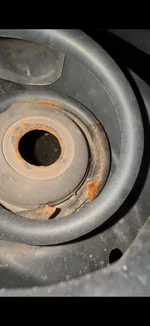
2013~2016 Rear Suspension Knock

I’ve got a 2016.5 CX5 GT with an interesting knocking/rattling when going over bumps. The sound is specifically coming from the driver side - rear and only makes noise when that driver side - rear wheel hits a large enough bump or undulation. I have already narrowed it down to the driver-side rear, and secured anything in the trunk that could be making this sound.

Below is a video of what it sounds like. I see there are a few TSBs relating to the rear suspension. Rear coils can snap, rear shock top mounts can snap, and rear differential bushings can fail prematurely. My money was on the shock top mounts but it visually checks out. Grabbed sway bar link and I could not move it with my hand at all.

Can it likely still be the top mount of the shock even if it visually checks out? Are loose rear shock mounting bolts common? The Original shocks are still on the car and to my knowledge have never been removed or serviced. Any ideas or experience?
 

Attachments

  • IMG_0207.mov
    14.4 MB
Last edited:
I wasn't clear on whether or not you checked the shock mounts bolts for looseness? That's the first thing I'd check. An upper mount came loose on a Honda we once had and the rattling was horrible.
 
Yeah I’ll get torque specs and double check the mounting bolts haven’t loosened. What is the best way to diagnose sway bar end links?
 
What is the best way to diagnose sway bar end links?

This might help.

From the 2014 workshop manual:

Front Stabilizer Control Link Inspection

  1. Remove the front stabilizer control link. (See FRONT STABILIZER REMOVAL/INSTALLATION.)
  2. Inspect for bending or damage. If there is any malfunction, replace the front stabilizer control link.
  3. Rotate the front stabilizer control link ball joint stud 10 times and shake it side to side 10 times.
  4. Measure the front stabilizer control link ball joint rotational torque using an Allen wrench and a torque wrench.

  • Front stabilizer control link ball joint starting torque: 0.8—3.5 N·m {8.2—35 kgf·cm, 7.1—30 in·lbf}
  • If not within the specification, replace the front stabilizer control link.
  • Even if within specification, if there is excessive play in the front stabilizer control link ball joint, replace the front stabilizer control link.
 
With the suspension hanging free, to check for play, I just grab the ends and try to force the stud in and out of the "socket".
 
So my understanding is a drooped multi link rear suspension actually puts the sway bar links at higher tension than if the car was just sitting at right height.

I looked into possibly removing the trunk side paneling to get a better look at the shock top mount from the interior, maybe go for a drive with it exposed and look for movement. Very little information out there on doing that and it looks involved.

I’m thinking I’ll actually remove the rear shock top nuts, compress the shock so I can get at the compression nut holding the top mounting bracket on, retorque that, then reinstall the top mounting nuts and retorque. Maybe it’s possible the compression nut has loosened as well
 
I highly doubt it's the sway bar link. And you are correct, the links are not under tension at ride height. You should be able to easily see and touch the rear links without jacking up the car. They should be pretty solid if you wiggle them. They are just beside the coils, closer to the centre of the vehicle.

You can't tank any panels off from the interior to see the top of the shock, it's inside the metal wheel well which is sealed. Only way to see it is from inside the wheel well.

Top mount is actually quite easy to remove. Just 2 14mm bolts. You should be able to compress the shock by hand (and wiggle it) once that is off and see if the top mount has any play in it. It's possible with the wheel on but much easier if you take it off.

Also check the rear diff bushing. The main one is dead centre of the vehicle inside the frame rail, visible from the rear.
 
Thanks for the responses guys. Well after taking a harder look today it seems I have found the source. Turns out the rear driver side coil spring broke at some point.

Now there is a TSB out on this very specific issue for my vehicle (TSB: 02-015/18). Since it failed in the exact way the TSB describes and it is a safety hazard, do you believe a Mazda dealer might cover the cost through goodwill assistance? Would they cover the cost of replacing both rear coils as I’m sure the rear passenger side coil is part of the same potential failure batch.

Not to mention, the updated designs are different than the old, so fixing one side would mean the car might sit weird with the updated design only on one side. Anyone have experience with this scenario, am I SOL?
 

Attachments

  • IMG_0223.webp
    IMG_0223.webp
    48 KB · Views: 11
Last edited:
Thanks for the responses guys. Well after taking a harder look today it seems I have found the source. Turns out the rear driver side coil spring broke at some point.

Now there is a TSB out on this very specific issue for my vehicle (TSB: 02-015/18). Since it failed in the exact way the TSB describes and it is a safety hazard, do you believe a Mazda dealer might cover the cost through goodwill assistance? Would they cover the cost of replacing both rear coils as I’m sure the rear passenger side coil is part of the same potential failure batch.

Not to mention, the updated designs are different than the old, so fixing one side would mean the car might sit weird with the updated design only on one side. Anyone have experience with this scenario, am I SOL?

In this case, the TSB clearly admits a design defect, with a solution that replaces the defective part with a redesigned part. You can try to make the case that this is a safety hazard. If I were you I'd be pushing for replacement of both coil springs since you wouldn't want to risk the other coil spring breaking while driving.

If they don't want to provide any assistance, I would buy only the springs, then get a quote for replacement and compare quotes from an independent shop.
 
TSB's aren't federal recalls. The OEM (Mazda) is saying, on the record, there's something wrong, but they are not legally obligated to fix it or help financially. Recalls are, by law, required to be fixed by the OEM. Recalls by nature mean that the defect has a high probability to cause bodily harm or death to passengers inside the vehicle and or other drivers on the road. TSB's are still very helpful as they allow the local dealers to quickly identify common issues and have Mazda approved fixes for those problems. But the cost of parts+labour are on us (the consumer). IF you have a really great relationship with your local Mazda dealer they may cut you a deal, possibly use a warranty labour rate instead of their standard labour rate. But yeah. The more you know! :)
 
Back