Intake Manifold Modifications.....

TurfBurn said:
That seems higher than around here... but you also have cams on that.. so I don't know how much that is. Even at the import race shop (King Motorsports) that is near here the full head job with a flow bench is like 900 or something. The guy I'm doing mine with is doing a full port and polish matched out to the gaskets and matching the mating on the intake manifold. He is putting on as many angles as he can on the valves (limited by space for the cutters), back cutting the valves, doing the seats, chamfering galley oil ports, radiusing the exhaust valves etc... full deal and it will be about 950, but no flow bench... which is fine as that is relatively minimal in the end of this (little differnce between a well done job and a "perfect" job as far as power). Although it can become important if you are doing NA. Also, I am not oversizing any valves this time around, so flow benching is unecessary as you are not affecting velocity, and it is hard to actually hurt your flow throughput if your velocity is maintained/raised and you generate less restriction due to the better valve work.

Anyone flowed a stock FS head yet?
 
flat_black said:
The hole to the outside would leave a huge vacuum leak. Very, very bad. The ones between the runners themselves can be safely left open.

Might as well leave them open since there is the massive gap that the stock backcuts on either side of the ports create anyway.. plugging the between runner holes would be a waste of time.
 
I like wasting my time, though! =) 'Sides, it looks sexier when they're plugged. ;)

See? =)

polished.jpg
 
Been thinking about what twilight said about using the (pretty much useless) VICS to make a dual runner intake.

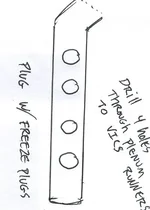
I want to take the plenum, holesaw drill through to the VICS to connect it to the plenum and give the car the capability of having a dual runner intake.

My only question: When does the VICS kick in?
 

Attachments

  • crudeassdrawing.webp
    crudeassdrawing.webp
    16.6 KB · Views: 212
That would be perfect then.

It just makes no sense that the VICS runners are siolated from the main plenum.

Not very effective.
 
PR5Matt said:
I just don't trust epoxy, and it is about impossible to tig inside those little ports, though I may try.
I talked to one of the welders (very experienced welder too) in the fab shop where I used to work a year ago about welding the manifold from my neon. He said that because of it's cast that it has a higher chance of warping.
 
PR5Matt said:
It just makes no sense that the VICS runners are siolated from the main plenum.

Not very effective.
(wow)
Do some more research into variable inertia charging systems before you get rid of it. Or ask an acoustical engineer about resonance and pressure waves. Here's a snippet of what you will find:

This system uses a separate intake air plenum, located above the main intake manifold. This second plenum is separated from the primary manifold by 4 butterfly valves, which open between 5000 and 5300 rpm and are activated by manifold vacuum. When the valves open, the added volume of the secondary plenum creates a higher resonance frequency, which in turn creates a sonic pressure wave. This sonic pressure wave arrives at each pair of intake valves just as they open, promoting more rapid and complete cylinder filling.
 
Last edited:
ddogg777 said:
(wow)
Do some more research into variable inertia charging systems before you get rid of it. Or ask an acoustical engineer about resonance and pressure waves. Here's a snippet of what you will find:

Sonic resonance occurs naturally in engine intake tracts. The VIC
system takes advantage of the phenomenon with a set of valves
between two chambers in the intake manifold. At lower speeds,
the valves are closed, producing a frequency that increases
cylinder charging. At higher rpm, the valves open, muting the
resonance so intake inertia can better fill the cylinders.

The truth be told....

Dual runner and VICS are (in PURPOSE) the same thing... the ONLY reason for dual runner is to tune a runner length to match for the rpm's. I can put up all the calculations if you want... typically each runner configuration is effective in a narrow band of frequencies... typically associated with about a 300-500 rpm window where it reaches peaks. There are also several windows of maximum detriment due to the way the pressure waves travel in the runners.

The purpose then of building a dual runner manifold is to allow for more than one 300-500 rpm window that has a peak efficiency due to the speed that the waves travel. Mind you this also changes due to pressure, temperature, and humidity.. the pressure waves move at the speed of sound through the air in the tract, and thus as the speed of sound changes the wave speed changes.

Now given all that information... the VICS in our car essentially generates frequency alterations that allows for the pressure wave travel speed to be altered such that it can peform on a single set of runners with essentially the same characterstics and behavior of a dual runner system. I'm not up on the engineering enough to know what drawbacks if any exist in that system... but the fact is the VICS in our cars is already tuned for the rpm bands that our vehicles perform in.
 
Yea, I know about the theory, but it just seems ineffective to me. I guess my old SHO, with its actual dual runner system, ruined me. :)

I just want to try it as a sort of "Oh, what the hell..." exercise.

I love to experiment.

Heck, I had a 1990 F-150 with a stock truck short-block 302, with GT-40 heads, Edelbrock EFI intake, Mustang roller cam, and converted the non-sequental speed density EFI to the mustang SEFI with MAF by wiring it myself with just a Haynes manual as a guide, headers and Bassini x-pipe, C-4 tranny swap, etc..
A 35th (I think that was the year. It was an new Gen car.) Anny. Trans Am (the White and blue ones) tried to race me, and with little traction I still sat right beside his door between stoplights.
 
Last edited:
I read all 24 pages right now and I understood about 50%(dunno) (shrug) of it what does VICS and VTCS stand for (acronym?) Subscribing want to see what yall come up with, I am here to learn.
 
VTCS stands for Variable Tumble Control System and VICS stands for Variable Inertia Charging System.

VTCS is used for emissions, to promote a warmer burn durring startup, which in turn heats the precat faster, but in normal, warm operation, adds a detrimental set of butterflies to the mix, which just serves to block flow.

VICS is essentially like a simplified version of Mazda's VRIS (Variable Resonance Induction System). Where the VRIS activates and deactivates runners and whatnot at various points in the RPM range (Usually four), VICS activates the butterflies at 5250 rpm. This doesn't provide a second set of runners, but rather ACTS like a shorter set of runners by creating a resonance , forcing air down into the sub-plenum that rests above the normal plenum, and it swirls back up, at an increased velocity due to the the resonance of the air being forced in a loop, basically.

This just allows the engine to be at it's peak operation both above and below the 5250 rpm, making it so the power doesn't just 'drop off', or come on very slowly.

Hope this helps a little bit. =)
 
Last edited:
Back