Test Drive: Mazda 5

mikeyb

Member
Contributor
:
01 BMW 325xi Touring
Mazda-5-2261010430313941600x1060.jpg


Mazda-5-2261010430325341600x1060.jpg


What is it?

It's the revised Mazda 5, launched at the Geneva show back in March and driven here on a 'sneak preview' - which means full mechanical spec but a few grey areas when it comes to trim levels.
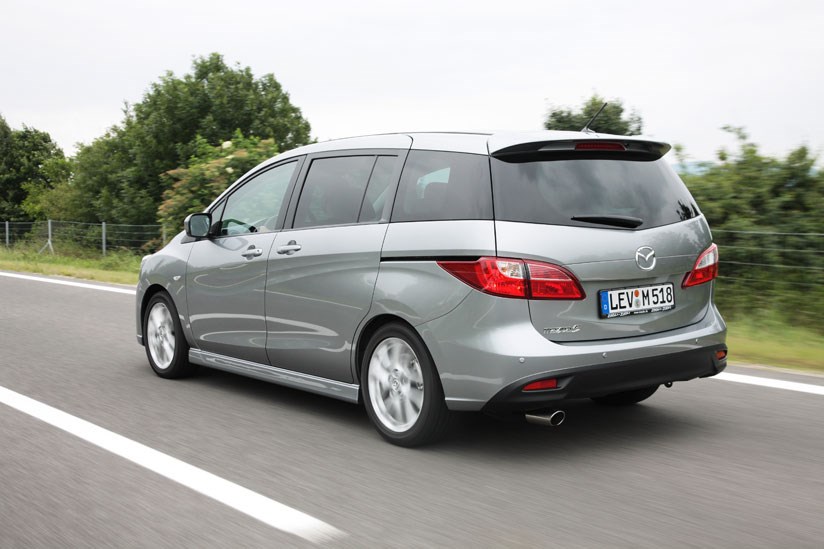
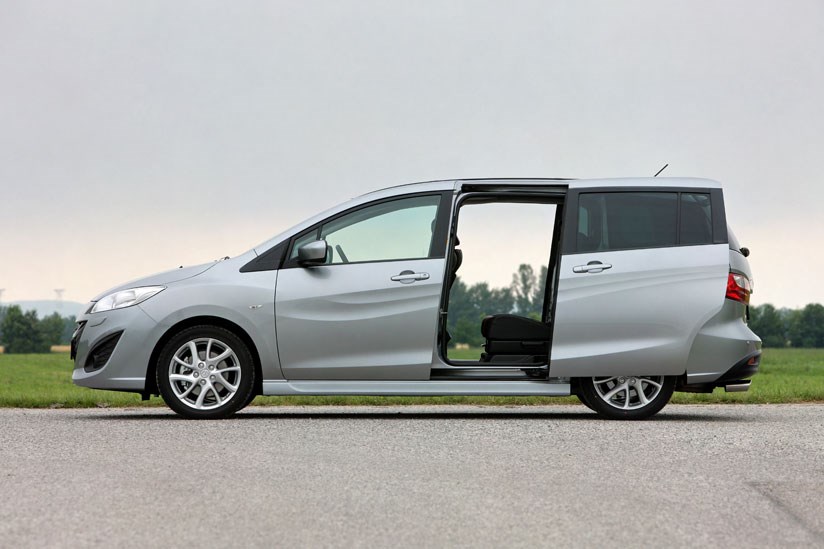
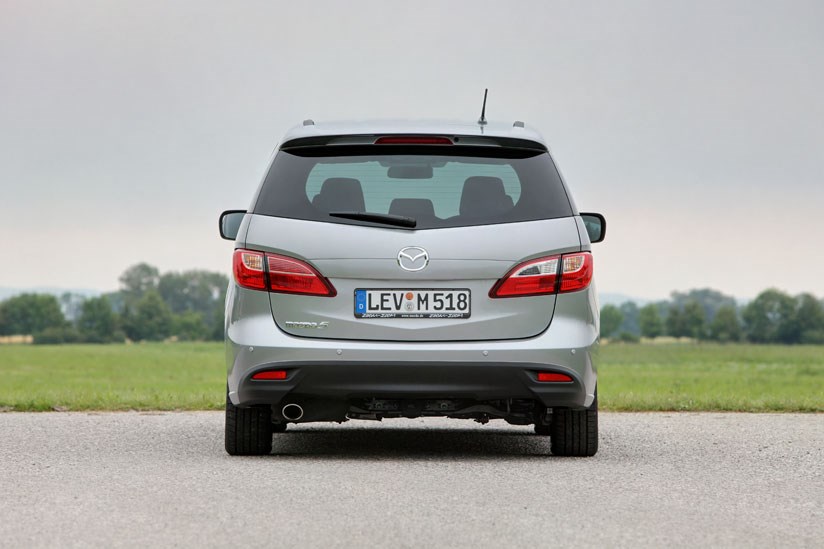
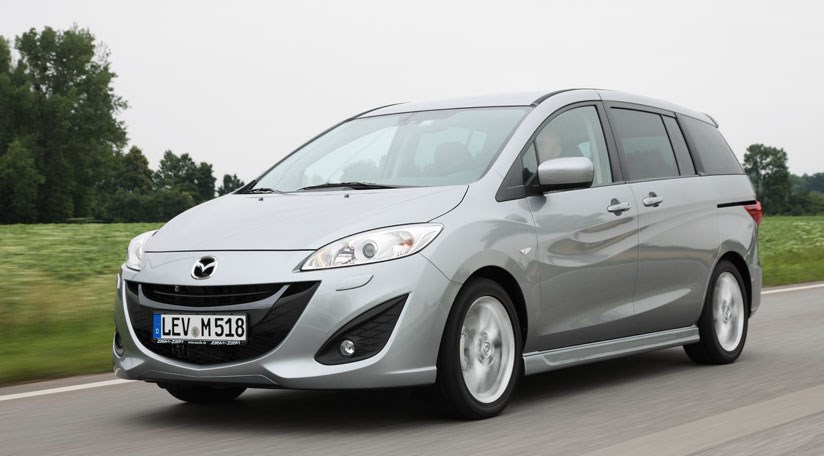
Visually the 5 marks a fresh attempt by Mazda to integrate its 'Nagare' design language into an MPV. That adds up to unusual creases along the flanks, but they do a decent job of breaking up what would be a slab of metal. It's less effective at the rear three-quarter which, thanks in part to the sliding rear door rails, looks uncomfortably heavy.
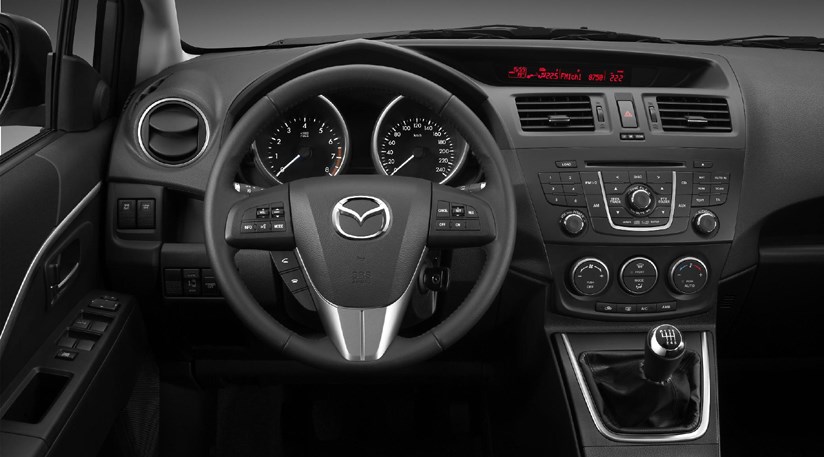
Elsewhere the 5 gets a revised interior, with improved cabin materials, new wheel designs and better NVH protection. And it keeps its third row of seats that folds into the floor.
The engine options are restricted to just two petrol motors; the existing 1.8-litre MZR unit gets an update to 113bhp and 122lb ft, as well as a six-speed transmission for the first time. It's slightly cleaner and more economical than before, too.
The other powerplant is new to the 5; it's a 2.0-litre MZR motor with Mazda's i-stop, a stop-start system that the firm claims is faster to restart than those of rival manufacturers. The new engine has 148bhp and 141lb ft, but is 13 per cent more economical than the outgoing 2.0, and emits 15 per cent less CO2, at 159g/km. It's also Euro5-compliant.
A diesel will follow early next year, incidentally; it's expected to be a 1.6-litre PSA-sourced unit.
What's it like?

An intriguing blend of part-driver's car, part-everyday MPV - but not entirely convincing at either role. Mazda has focused hard on what it calls "perfectly consistent linearity", which translates into linear steering, throttle and brake pedal feel.
It works, too. Few other cars in this class have such a sweet feel on turn-in, helped by excellent body control for a car of this size.
If only the engine were more willing to take advantage of this experience. We tried the 2.0-litre direct-injection unit and while it was smooth and, you've guessed it, linear in its power delivery, it feels like some of its potential has been sacrificed in the name of lower CO2 emissions.
Certainly the revised, taller gearing doesn't do it any favours, but it feels more like a slightly overwhelmed 1.6 than a 2.0; you can see why small turbos, such as VW's 1.4 TSi unit, are taking over.
Thing is, the chassis tuning - centred on improving the car's progression from braking to cornering to acceleration - has resulted in a ride which, while fine on smooth Austrian routes, could be caught out by Britain's latest generation of super-potholes. It's not horrendous, but the damping is definitely on the firmer side of the class average.
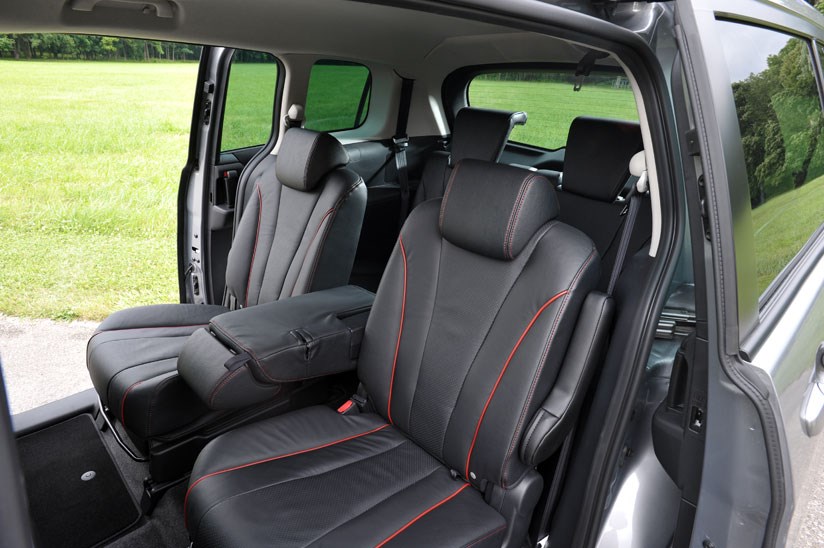
The cabin retains plenty of practicality, with a modular second row of seats. But while the fit and finish feels solid enough, too many of the visible surfaces are still hard to the touch for the interior to feel 'premium'.
Should I buy one?

http://www.autocar.co.uk/car-reviews/mazda-5-2.0-i-stop/250660/pictures/mazda-5-2.0-i-stop.aspx
You should consider it; if you're prepared to work that 2.0-litre motor hard then there is a modicum of fun to be had here, and that's hardly the norm in the MPV segment.
But it could be worth a wait; engine progress elsewhere - in small petrol turbos and turbodiesels - means Mazda will need to expand the range sooner rather than later.

[autocar]
 
How lame! They couldn't even take photos of the 5 when they were test driving it.
 
2010 Mazda 5 2.0 DISI


Mazda will replace its 5 midi-MPV in autumn 2010 and CAR's just driven the new minivan. The new Mazda 5 (2010) is the first production car to bear the full fruits of the company's much-vaunted 'Nagare' design policy, with some highly unusual sculpting on the flanks.
As you can read in our news story here, that design direction is being wound back after the departure of its champion, design director Laurens van den Acker who defected to Renault. Which makes the Mazda 5 something of a curio: this could end up being the only Mazda to wear its Nagare styling on its sleeve.

So the new Mazda 5 will be the last wavy Mazda?

Sort of. Don't expect every last nuance of the Nature-inspired Nagare programme to be ditched overnight, but the general feeling is it was too fussy. So cleaner, more elegant, simple designs will be forthcoming, CAR understands.

The 5 is quite boxy and, although Mazda touts this as a new model, it is in fact a carryover of the previous 5 under the skin. The glasshouse, roof and basic architecture are all the same as before just spruced up with some new panels, a new IP on the dashboard and a host of new technology
under the bonnet.

The twin sliding rear doors remain, however. They're a real practicality boon, making opening the doors so much safer (they take up just 160mm of space when open). They're electrically operated on higher spec models, or as an optional extra.


Hmmm. The new 2010 Mazda 5 looks challenging!

It's quite colour and angle sensitive. Those meandering side styling lines work well in some lights, but look fussy from others. It's like the surface entertainment on a Seat cranked up to 11.
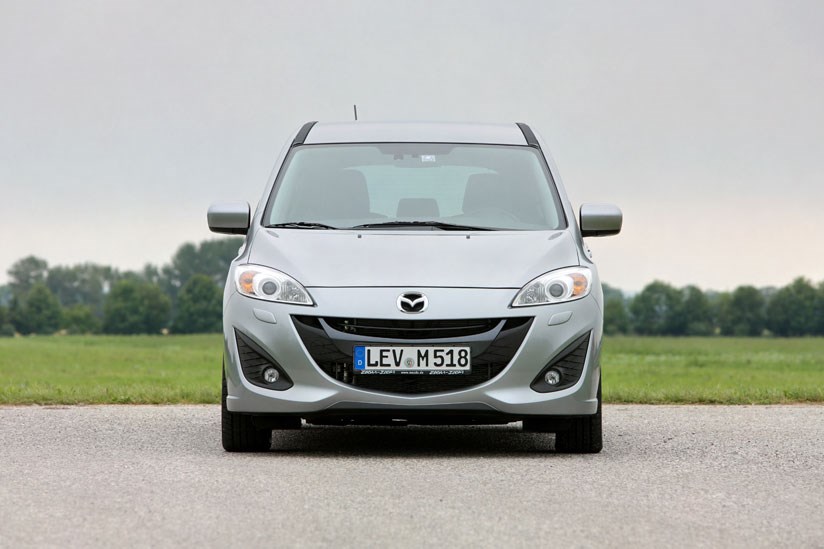
While the front end of the 5 is all family-spec Mazda gobby, like on the 3 hatchback, the rear end is less successful. They've ditched the vertical lights on the old midi-MPV and replaced them with chunky, horizontal items that lend the rear aspect a dumpy look.
In fact, spying an outgoing Mazda 5 on the launch made me think this whole design is a massive step backwards.


On the road in the new Mazda 5

We drove the new 2.0-litre petrol engine - the big news on the 2010 relaunch. It's the first appliation of Mazda's new direct-injection tech with stop-start on its full size petrol, which will be priced from around 20k when UK deliveries start in autumn 2010. A 1.8-litre petrol makes up the other UK launch engine; while it costs less (from 17,500 approx), its inferior performance, economy and emissions makes you wonder why people would bother.
Around two-thirds of UK buyers will plump for a petrol, says Mazda, citing its high retail penetration for the lack of diesel appetite. But a new, downsized derv is coming in spring 2011 - we expect a 1.6 diesel, which could well be the engine of choice.
How is Mazda's new 2.0 DISI engine?

Pretty refined. The gearing is so tall you often find yourself being prompted to change up by the gearchange reminder (one of the best yet, subtle but tends to be right. Unlike many rival systems). Mazda claims the new 5 is no heavier than before, despite more body rigidity work, yet the top-spec 2.0 MPV feels sluggish.
Fact is, it'll be more than adequate for most buyers. Buyers in this sector don't crave a hit of acceleration, but the 2.0 does feel very slow and many of those economy gains will surely be lost if you thrash it for overtaking or even just keeping up on the motorway. Although we haven't yet tested it, the weedier 1.8 petrol will only exacerbate this. The new 2.0 is at least a sweet revver, spinning happily to its 6500rpm redline and the gearchange is a typical Mazda slick affair, making cog-swapping a fun pasttime.
The i-Stop system works as well as expected. Mazda claims it's among the fastest in class to start up, but these milliseconds are hard to judge. All we know is you'll never fool it. The engine cuts out the moment you select neutral at the lights and is unfailingly ready the moment you brush the clutch.

Ride and handling?

The Mazda 5 enjoys a soft set-up. The ride is plumpy, softening up most road intrusions and the cabin ambience is quiet. Thanks to that high gearing and good NVH insulation, the loudest noise at a motorway cruise is the blustering wind whistle. This is one relaxing place to sit.
Our car rode on 16in rims; just be warned that other models on 17s were said to be noisier and more fidgety.
Mazda has spent ages working on a soft transition of g-forces during cornering and they've succeeded; the 5 displays an almost total lack of fun when hustled, yet it contains its bulk well and the chassis is entirely predictable. A squeal of tyre rubber and gentle understeer is order of the day. The steering is light and well geared for a car of this ilk.
Enough driver chat! This is an MPV. Is it practical?

This is where the Mazda 5 rules. UK versions will come as standard with seven seats and the packaging is really clever. Considering this car stretches to 4.5m long, it's seriously roomy in there.
Configure the 5 as you wish. As a four-seater, there's plenty of space for bags and two middle-row passengers. Flip up the left-mid pew and a fifth, occasional seat swings into play. The simplicity of the Karakuri seats' engineering is a marvel to behold and it's clever how you can step through the middle seat gap for access to the rear.
If you need seven seats, the two rearmost chairs pop up from the boot floor easily. Like the Ford S-Max, the seat operation is a cinch. Legroom is more compromised in the third row, but small children will be fine and you can even squeeze your mates in for a run back from the pub. I wouldn't want to be in that back row in a rear-end shunt, mind you.
The pop-up headrests on all five rear seats seriously mess up your view back too, but they slide down when not in use. The view forwards is fine, a slight chunkiness to the A-pillars the only real glitch. The dash plastics on our late pre-production cars were grainy and hard; let's hope the finished ones have slightly more give. But the general cabin layout is Playmobil simple - the instrumentation and switchgear are logical and easy to operate.
Verdict

The Mazda 5 is an interesting proposition. Frankly, they've taken a big step backwards in the design, which is a shame. The outgoing 5 was elegance personified, the new one willfully gauche. It doesn't work and it's telling that 'Nagare' design is being quietly sidelined.
But the 5's driving experience is well oiled and precise, as you'd expect of a Mazda. It's 100% geared up for family duties so it won't entertain like an S-Max or even a Zafira, and in our view that's a correct decision.
The new 2.0 DISI direct-injection petrol is refined and willing and the driving experience soft, supple. But considering that same 2.0 is the top-spec option, performance is mightily disappointing. A downsized 1.4 or 1.6 turbo may work better, as used by rivals.
The best bit? The massive practicality on offer in a well equipped, well built package. The new Mazda 5 hides its light under a rather ugly bushel.

Statistics

How much? 20,000 On sale in the UK: October 2010 Engine: 1998cc 16v four, 148bhp @ 6000rpm, 141lb ft @ 4500rpm Transmission: Six-speed manual, front-wheel drive Performance: 11.0sec 0-62mph, 121mph, 40.9mpg, 159g/km How heavy / made of? 1485kg/steel How big (length/width/height in mm)? 4585/1750/1615
CAR's rating

Shared%5Cimages%5Cratingstars_web8.gif
4

Handling
Shared%5Cimages%5Cratingstars_web6.gif
3
Performance
Shared%5Cimages%5Cratingstars_web4.gif
2
Usability
Shared%5Cimages%5Cratingstars_web10.gif
5
Feelgood factor
Shared%5Cimages%5Cratingstars_web8.gif
4
Readers' rating
Shared%5Cimages%5Cratingstars_user6.gif
3


[CAR]

[
 
The Mazda 5 is an interesting proposition. Frankly, they've taken a big step backwards in the design, which is a shame. The outgoing 5 was elegance personified, the new one willfully gauche. It doesn't work and it's telling that 'Nagare' design is being quietly sidelined.

Couldn't have said it better.

I may be biased though. Still waiting for the options for what is coming over here though. I'm pretty sure it won't be the 2.0L. Although i-stop would be nice.
 
Back