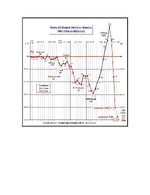
Something to think about. Downer though.
The Budget Deficit Death Spiral
by Robert Freeman
Lenders talk about a debtors death spiral. It occurs when borrowers get so far in over their heads they begin borrowing money just to cover the interest payments on past borrowings. The borrowers have to do this to keep the lending flowing but they can no longer plausibly pay down the principal. As new debt compounds on old, bankruptcy becomes imminent. Further lending is foolhardy. Foreclosure is only a matter of time.
The U.S. is starting to look like it is entering just such a death spiral. It is foretold not simply by the large and growing deficits, nor by the fact that their carrying costs will rise quickly as interest rates rise. Rather, it is the fact that these trends are becoming irreversible, a structural part of the U.S. economy.
When the ultimate collapse will occur, whether it comes with a bang or a whimper, how it will be triggered, and how severe it will be are as yet unknown. But as Herbert Stein, Chairman of the Council of Economic Advisers under Richard Nixon was fond of saying, Things that cant go on forever, dont.
The first signs of impending trouble are the exploding budget deficits themselves. They began, of course, under the parlous economic stewardship of Ronald Reagan. Reagan cut the marginal tax rate on the wealthiest of Americans from 70% to 38%. He promised it would spur an orgy of investment and rocket the economy to new levels of production and prosperity. Instead, his supply side economics did the exact opposite. It produced the deepest recession since the Great Depression.
Output fell 2.2% in 1982 while budget deficits soared. When Reagan took office in 1981, the national debt stood at $995 billion. Twelve years later, by the end of George H.W. Bushs presidency, it had exploded to $4 trillion. Reagan was a B grade movie actor and a doddering, probably clinically senile president, but he was a sheer genius at rewarding his friends by saddling other people with debts.
Bill Clinton reversed Reagans course, raising taxes on the wealthy, and lowering them for the working and middle classes. This produced the longest sustained economic expansion in American history. Importantly, it also produced budgetary surpluses allowing the government to begin paying down the crippling debt begun under Reagan. In 2000, Clintons last year, the surplus amounted to $236 billion. The forecast ten year surplus stood at $5.6 trillion. It was the last black ink America would see for decades, perhaps forever.
George W. Bush immediately reversed Clintons policy in order to revive Reagans, once again showering an embarrassment of riches on the already most embarrassingly rich, his base as he calls them. He ladled out some $630 billion in tax cuts to the top 1% of income earners. In true Republican fashion, they returned the favor by investing over $200 million to ensure Bushs re-election. Do the math. A $630 billion return on a $200 million investment: $3,160 for $1. Ill give you $3,160. All I ask is that you give me $1 back so I can keep the goodness flowing. Do we have a deal? Republicans know return on investment.
But the cost to the public has been a return to the exploding deficits of the Reagan years. Bush blew through Clintons surplus in his first year. The 2004 deficit reached $415 billion, a record. Still, its real size is masked by the fact that Bush has shifted $150 billion from the Social Security trust fund in order to make the shortfall look smaller. Its like pretending youre richer when you move money from one pocket to another. Both sums have to be repaid, so the real amount borrowed is the $415 billion nominal deficit plus the $150 billion from Social Security or $565 billion.
This shell game with federal trust funds taints all official forecasts about Bushs deficits going forward. For example, the Congressional Budget Office estimates Bushs cumulative ten year deficit at $2.3 trillion, to be sure, a breathtaking shortfall from the $5.6 trillion surplus he inherited from Clinton. But as with the yearly number, this one ignores the trust fund sleight of hand, an omission of some $2.4 trillion. When this is added back in, Bushs ten year deficit leaps to $4.7 trillion, $10.3 trillion short of Clintons number.
But even that number is understated because the CBO forecasts are based on current law. Bushs tax cuts have not yet been made permanent. If Bush is re-elected and the cuts are made permanent, that would add another $3.2 trillion to the shortfall. It was not too long ago that a $3.2 trillion increment to anything would have made sober peoples noses bleed but such figures are mere accounting details to the Big Thinkers in the White House, especially since it will not be their constituents who are paying it back.
Add it all togetherthe nominal deficit, the stealth siphoning from Social Security, and the permanent effects of Bushs tax cutsand the 10 year deficit explodes to a mind-boggling $7.9 trillion. Within ten years, the government will owe more than $15 trillion. And this, at precisely the time the government needs fiscal solvency to begin paying the Baby Boomers their Social Security.
This run-up in debt represents the most rapid, predatory looting of public wealth in the history of the world. The interest costs alone will consume the government and, soon, the entire economy. In fiscal 2004, interest costs came to $321 billion against a deficit of $415 billion. So three quarters of all the current year borrowing is spent paying interest on past borrowing. This is the most immediate symptom of the deficit death spiral.
And the situation will only get worse when interest rates rise, as they must. The U.S. has enjoyed an unprecedented period of low rates, the lowest in 50 years. The only direction they can go is up. And they will rise quickly once foreigners, who are more and more the buyers of U.S. debt, become saturated with dollars and begin to eschew additional lending.
Complete Story...
It goes on to talk about how Nixon's deficit spending lead Arab nations to declare that the US currency was no longer valuable as it was no longer backed by gold, and tripled oil prices for sale to the US in 1973, and again in 1978 - causing large oil shortages. Also goes on to explain the ever widening income gap and the precarious balance that the US dollar has with the currency exchange. Long article, but worth a read.
The Budget Deficit Death Spiral
by Robert Freeman
Lenders talk about a debtors death spiral. It occurs when borrowers get so far in over their heads they begin borrowing money just to cover the interest payments on past borrowings. The borrowers have to do this to keep the lending flowing but they can no longer plausibly pay down the principal. As new debt compounds on old, bankruptcy becomes imminent. Further lending is foolhardy. Foreclosure is only a matter of time.
The U.S. is starting to look like it is entering just such a death spiral. It is foretold not simply by the large and growing deficits, nor by the fact that their carrying costs will rise quickly as interest rates rise. Rather, it is the fact that these trends are becoming irreversible, a structural part of the U.S. economy.
When the ultimate collapse will occur, whether it comes with a bang or a whimper, how it will be triggered, and how severe it will be are as yet unknown. But as Herbert Stein, Chairman of the Council of Economic Advisers under Richard Nixon was fond of saying, Things that cant go on forever, dont.
The first signs of impending trouble are the exploding budget deficits themselves. They began, of course, under the parlous economic stewardship of Ronald Reagan. Reagan cut the marginal tax rate on the wealthiest of Americans from 70% to 38%. He promised it would spur an orgy of investment and rocket the economy to new levels of production and prosperity. Instead, his supply side economics did the exact opposite. It produced the deepest recession since the Great Depression.
Output fell 2.2% in 1982 while budget deficits soared. When Reagan took office in 1981, the national debt stood at $995 billion. Twelve years later, by the end of George H.W. Bushs presidency, it had exploded to $4 trillion. Reagan was a B grade movie actor and a doddering, probably clinically senile president, but he was a sheer genius at rewarding his friends by saddling other people with debts.
Bill Clinton reversed Reagans course, raising taxes on the wealthy, and lowering them for the working and middle classes. This produced the longest sustained economic expansion in American history. Importantly, it also produced budgetary surpluses allowing the government to begin paying down the crippling debt begun under Reagan. In 2000, Clintons last year, the surplus amounted to $236 billion. The forecast ten year surplus stood at $5.6 trillion. It was the last black ink America would see for decades, perhaps forever.
George W. Bush immediately reversed Clintons policy in order to revive Reagans, once again showering an embarrassment of riches on the already most embarrassingly rich, his base as he calls them. He ladled out some $630 billion in tax cuts to the top 1% of income earners. In true Republican fashion, they returned the favor by investing over $200 million to ensure Bushs re-election. Do the math. A $630 billion return on a $200 million investment: $3,160 for $1. Ill give you $3,160. All I ask is that you give me $1 back so I can keep the goodness flowing. Do we have a deal? Republicans know return on investment.
But the cost to the public has been a return to the exploding deficits of the Reagan years. Bush blew through Clintons surplus in his first year. The 2004 deficit reached $415 billion, a record. Still, its real size is masked by the fact that Bush has shifted $150 billion from the Social Security trust fund in order to make the shortfall look smaller. Its like pretending youre richer when you move money from one pocket to another. Both sums have to be repaid, so the real amount borrowed is the $415 billion nominal deficit plus the $150 billion from Social Security or $565 billion.
This shell game with federal trust funds taints all official forecasts about Bushs deficits going forward. For example, the Congressional Budget Office estimates Bushs cumulative ten year deficit at $2.3 trillion, to be sure, a breathtaking shortfall from the $5.6 trillion surplus he inherited from Clinton. But as with the yearly number, this one ignores the trust fund sleight of hand, an omission of some $2.4 trillion. When this is added back in, Bushs ten year deficit leaps to $4.7 trillion, $10.3 trillion short of Clintons number.
But even that number is understated because the CBO forecasts are based on current law. Bushs tax cuts have not yet been made permanent. If Bush is re-elected and the cuts are made permanent, that would add another $3.2 trillion to the shortfall. It was not too long ago that a $3.2 trillion increment to anything would have made sober peoples noses bleed but such figures are mere accounting details to the Big Thinkers in the White House, especially since it will not be their constituents who are paying it back.
Add it all togetherthe nominal deficit, the stealth siphoning from Social Security, and the permanent effects of Bushs tax cutsand the 10 year deficit explodes to a mind-boggling $7.9 trillion. Within ten years, the government will owe more than $15 trillion. And this, at precisely the time the government needs fiscal solvency to begin paying the Baby Boomers their Social Security.
This run-up in debt represents the most rapid, predatory looting of public wealth in the history of the world. The interest costs alone will consume the government and, soon, the entire economy. In fiscal 2004, interest costs came to $321 billion against a deficit of $415 billion. So three quarters of all the current year borrowing is spent paying interest on past borrowing. This is the most immediate symptom of the deficit death spiral.
And the situation will only get worse when interest rates rise, as they must. The U.S. has enjoyed an unprecedented period of low rates, the lowest in 50 years. The only direction they can go is up. And they will rise quickly once foreigners, who are more and more the buyers of U.S. debt, become saturated with dollars and begin to eschew additional lending.
Complete Story...
It goes on to talk about how Nixon's deficit spending lead Arab nations to declare that the US currency was no longer valuable as it was no longer backed by gold, and tripled oil prices for sale to the US in 1973, and again in 1978 - causing large oil shortages. Also goes on to explain the ever widening income gap and the precarious balance that the US dollar has with the currency exchange. Long article, but worth a read.
Last edited: