
You are using an out of date browser. It may not display this or other websites correctly.
You should upgrade or use an alternative browser.
You should upgrade or use an alternative browser.
Off Topic - Ethanol
- Thread starter rweatherford
- Start date
happy and angry
Member
RE: rweatherford in general:
http://www.google.ca/search?hl=en&q=corn+ethanol+global+food+price&btnG=Google+Search&meta=
Pick a link. Read. Start at the first one, the Financial Post article. This is what happens when you start converting a source of food into a source of energy, and while YOU might think "3-4%" inflation adjusted increase over a very short period of time isn't anything to worry about when it comes to food, many (most) experts disagree.
I take serious issue with any plan that contributes to places like Haiti turning mud into a staple food source. We are among the wealthiest 20% of the global population, we account for 80% of global energy and resource use, and apparently we still place employment rates and foreign oil dependence and money as being more important than the inevitable impact our actions will have on the rest of this god damn planet.
Your arguments aren't even worth dissecting, to be honest. They are mostly substance-free talking points that ignore what other people are telling you/showing you/linking to. You asked why people are against ethanol as a primary fuel source. You got an answer. Anything else?
http://www.google.ca/search?hl=en&q=corn+ethanol+global+food+price&btnG=Google+Search&meta=
Pick a link. Read. Start at the first one, the Financial Post article. This is what happens when you start converting a source of food into a source of energy, and while YOU might think "3-4%" inflation adjusted increase over a very short period of time isn't anything to worry about when it comes to food, many (most) experts disagree.
I take serious issue with any plan that contributes to places like Haiti turning mud into a staple food source. We are among the wealthiest 20% of the global population, we account for 80% of global energy and resource use, and apparently we still place employment rates and foreign oil dependence and money as being more important than the inevitable impact our actions will have on the rest of this god damn planet.
Your arguments aren't even worth dissecting, to be honest. They are mostly substance-free talking points that ignore what other people are telling you/showing you/linking to. You asked why people are against ethanol as a primary fuel source. You got an answer. Anything else?
rweatherford
Member
- :
- Mazda 5
Also, the 'byproducts credit' is something I'm not comfortable with. I'm not saying I eliminate it, but I'm dubious since those by-products are already being made/used (right?) and thus I suspect they are not relevant to the question of net energy balance.
CO2 can be made several ways. CO2 in this procedure is a by-product that is scavanged off the process, liquified and then sold to businesses such as Pepsi and Budwiser. The feed products that are produced are higher in protien per ton than regular corn. Therefore you need less to get the same nutritional value for swine and cattle. Since you need less tonnage your transport cost is also lower. The product also cost less to feed. It is a win for corn producers, ethanol producers and livestock producers.
If it's not a gasoline replacement, then the argument about jobs is out the window (which was your point I was rebutting). If it's just 'extra' fuel, then there's lots of potential sources and nothing to suggest that the ethanol option will yield more American jobs than a great number of the other options.
I disagree. Is the oil industry actually adding jobs? They have not increased the number of refineries. I'm doubting that any jobs have been added. Ethanol on the other had has added jobs at near 200 plants in the next year or two. It may be true that other fuels will make as many jobs. For now they are not here. Until then we won't know.
Perhaps you did.You were talking about American jobs and ethanol being good for rural America(ns). If the source of the ethanol is not an American agricultural product, as you pointed out that it wouldn't be in your reply to me, your argument is again completely out the window. It appears from your newer post(s) that you agree with me that corn, soybeans, etc. are poor choices for the ethanol 'feedstock,' and so you also agree (even if you don't realize it) that ethanol doesn't suggest more jobs for America(ns).
If in fact other sources become feedstocks for ethanol then corn will just go back to food and these other sources will replace it. Current facilities will change over to the other feedstocks. If it is financially feasable it will happen.
I'm sorry, you won't see this kind of switching back and forth between basic fuel sources unless the investment to completely supply everything both ways is made, thus raising the price of both before production even begins. Then, the farmers you talk about (and of which I was one) are put in a gigantic jam when OPEC increases production next August and the price comes down. What are they supposed to do with all the extra stuff they were growing for your ethanol plant? Make you eat it? And you suddenly want them all to go back to producing that stuff again when OPEC cuts back 18 months later. Sorry, no sale. But wait, I forgot, you don't want farmers producing the ethanol at all because there are other, better, cheaper sources from which to make it.
This has already happened. You just don't realize it. The investment has been made and the government has paid the oil companies $0.51 cents a gallon for doing it. This is the "Blenders Tax Credit" you read about but some studies apply to the Ethanol plants as a gift from the government, but it doesn't go to them. Ethanol is mixed at the distribution point of the pipeline and gas is trucked to your local gas station. If the price of oil goes down (man I hope so) in MO ethanol mixing of 10% will not be required. Of course if there is an excess of corn because of this we will eat it or send it overseas just like "normal". That is what most people are complaining about here. They don't seem to think this will happen and we will run out of food. Time will tell.
The thing is that a cornerstone of your (and so many people's) original argument was American jobs. This is a crock and your posts reflect the fact that you know it is, so please leave that basic tenet of your argument out of it.
Actually I don't know it. I guess I'll work on my understanding how this hasn't helped in my location because it sure seems that it obviously has. I do see how global increasing prices, whatever the reason can hurt the poorest of the poor and that is something to think about. I would not disagree that we are very fortunate to have such plentiful food source in the US.
rweatherford
Member
- :
- Mazda 5
RE: rweatherford in general:
http://www.google.ca/search?hl=en&q=corn+ethanol+global+food+price&btnG=Google+Search&meta=
Pick a link. Read. Start at the first one, the Financial Post article. This is what happens when you start converting a source of food into a source of energy, and while YOU might think "3-4%" inflation adjusted increase over a very short period of time isn't anything to worry about when it comes to food, many (most) experts disagree.
Ok I read and read and read. Most of them are the same and many from Canada. I am suprised at the amount of these negative articles are from Canadian sources and another is the "International Herald Times" which is a Paris based publication and owned by the New York Times. I wouldn't trust the NYT as far as I could throw the paper. Sorry.
Definately food suppy issues need to be watched. If you read the own articles you posted you will find that some give both sides and that either side has a valid arguement.
"In a counterpoint study last month by corn growers and the biofuels industry, higher corn prices were found to be only a small element in rising food costs overall – although higher energy costs for fuel to transport crops and grow them were a larger factor.
"This analysis puts to bed the argument that a growing domestic ethanol industry is solely responsible for rising consumer food prices," Bruce Scherr, CEO of Informa Economics, a food and agriculture research and consulting firm based in Memphis, Tenn., said in a statement.
The "farm value" of commodity raw materials used in foods accounts for 19 percent of total US food costs, down from 37 percent in the 1973. Higher costs for labor, packaging, transportation, and energy were a "key driver" behind higher food costs, the report said. "
From another article that you posted.....
""Currently we are spending about $2 billion a year on a subsidy for ethanol production, two and a half, approaching $3 billion a year on ethanol subsidies and there are estimates that this is saving probably $5 billion to $6 billion in government payments to farmers," he said."
So the tax load for ethanol has been a good investment for the US government. I guess it is a big shell game. Everyone was happy when they just gave it to the farmers so the consumer could eat for cheap.
Your arguments aren't even worth dissecting, to be honest. They are mostly substance-free talking points that ignore what other people are telling you/showing you/linking to. You asked why people are against ethanol as a primary fuel source. You got an answer. Anything else?
I am certainly not ignoring. I also did not ask about ethanol as a "primary" fuel source. I asked about negative reasons about production, which was turned into "primary fuel source" which I never expected ethanol to be. I'm not sure where that came from. I have read all the posts, responded as necessary and reviewed many of the cited sources. I think you are being quite assumptive in such a decision to say that I am ignoring them. I would not expect ethanol to be used as a primary fuel source because I understand that there is not enough production land available for both food and ethanol as a "primary" fuel source.
I guess we'll see if we run out of food. I think it will be difficult to get farmers to stop delivering to the highest bidder. Many times this is not necessarily the ethanol plant. Much of our corn also goes to swine feed mills. All of our soybeans go to ADM in the end because there is almost no other game in town. At least on the corn side there are many choices.
Happy eating. I am proud to produce food for over 150? people myself. (it's some statistic somewhere out there)
Last edited:
rweatherford
Member
- :
- Mazda 5
Man, you're really passionate about this E85 crap, aren't ya? lol... Kinda surprised you didn't purchase a FlexFuel vehicle for yourself with the amount of knowledge and support you have in the product.
(smoke) Show me a flex fuel vehicle that seats 6 (four carseats) as well as the Mazda5 and get's this kind of mileage.
 I love my 5. I've been a GM guy for a long time. I never stated that I think E85 is the future as some feel that it is. I have purchased E10 for years, before it was a "talking point" issue. I've never had any problems.
I think reduction in consumption is much more important for the future, which is part of my reason for purchasing the 5. Not many people with six in their family only own one car and make it a small one like the 5. For now that's all I can do. That's why I think some have judged me pretty quickly just because of my stance on support for ethanol as a supplemental fuel.
Anyway I see this as a good discussion and I have learned from it. Hope others have too. I've opened myself up to some new perspectives that I would not normally get in my location, which I feel is important to do for a persons personal growth. I'm not sure what the future holds, but we'll all find out I guess.
I will give you credit though... on a personal level. Usually when someone is this dedicated to their beliefs and they are found unpopular, the thread usually ends up going downhill into a flame fest... you seemed to have kept your composure well in the face of all of our yammering on the subject
I didn't read this thread word for word, but I agree that it was successful in getting a broad spread of viewpoints from both ends. While I don't think E85 is the end-all, be-all answer to our energy problems, I'll concede that it's at least a forward thinking approach and a relatively successful concept. We may not have enough of it, but at least it's a renewable resource.
I didn't read this thread word for word, but I agree that it was successful in getting a broad spread of viewpoints from both ends. While I don't think E85 is the end-all, be-all answer to our energy problems, I'll concede that it's at least a forward thinking approach and a relatively successful concept. We may not have enough of it, but at least it's a renewable resource.
Do I win teh prize? I $hit you not, this is trueTheres one BIG reason nuclear power is not being widely used in the US of A.
Anyone care to take a guess?


Last edited:
I am not terribly well read on the subject but I will toss my thoughts in the ring.
I have found that the average person is 2-5 years behind technology in understanding that technology. So often something is far more capable then the public thinks it might be based on out dated assumptions. Ethanol is a good case for this.
As for the corn becoming to expensive argument...I find this very unlikely. As with any commodity, as it becomes more profitable, more people grow it. People are only considering the mid-west where growing crops is still economically feasible. However, the US has millions of acres of land that could also grow crops and that inf act, did grow crops. Thinking of New England alone, we used to me nothing but farms now they hard to find. If Ethanol is found to be profitable enough you will see lots of new farms open. This will allow a completely localized process of fuel production in most all areas of the US. Add to this if the demand goes up for ethanol based on its ever increasing efficiencies and the ever decreasing stock of gasoline then the price should balance out.
Cars are not built to run on pure E85 and if they were the public may be more accepting to them as they would be more efficient then the duel purpose vehicles. Think about a hydrogen, an electric, or even a hybrid. Their is only one fueling system involved so they are inherently more efficient.
Corn, to my knowledge, is not yet been bio-engineered for fueling purposes. So it is very possible that the corn, or other sources of ethanol will be developed that are a far higher yield of ethanol.
I am by no means endorsing ethanol; I admit to being rather uneducated on the subject. So I am doing my best to apply rational thinking on a developing technology that is only fractionally established as what it seeks to supplement.
That said, I have a REAL problem with how fake other technologies are that people latch onto. Hybrids really piss me off in that they are a flat out waste of money. The average person will never make back the extra expense of a hybrid in fuel savings compared to the gasoline equivalent or the diesel alternative. On this subject, most of the alternative energy cars I have seen are wispy little things not fit for the real world. Given the same weights as these cars, I can make a gasoline car with 35 horse power get 100 mpg too. Its not hard when the vehicle only weighs 1000 pounds.
I think the real problem people have with E85 is the government invovlement in its developement compared to teh alternative fuel they like:
Hydrogen - Yeah, lets use water to power our cars becuase god knows there is enough clean water around.
Hybrid - Why did we not just buy cheaper car?
Electric - AWESOME lets use the least effecient form of energy we have today to power more stuff. There is a good reason that people have moved to propane and natural gas heating instead of electricity. Nuclear power could certainly help here. I doubt the current state of things involving extremists of all verities will allow this.
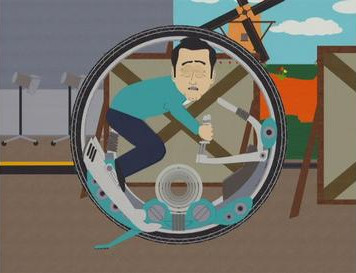
Compressed air - 1000 pounds, takes 3 hours to refueled by electricity cause more pollution and wasted energy then gasoline. Bah.
BEST CAR EVER!!!
I have found that the average person is 2-5 years behind technology in understanding that technology. So often something is far more capable then the public thinks it might be based on out dated assumptions. Ethanol is a good case for this.
As for the corn becoming to expensive argument...I find this very unlikely. As with any commodity, as it becomes more profitable, more people grow it. People are only considering the mid-west where growing crops is still economically feasible. However, the US has millions of acres of land that could also grow crops and that inf act, did grow crops. Thinking of New England alone, we used to me nothing but farms now they hard to find. If Ethanol is found to be profitable enough you will see lots of new farms open. This will allow a completely localized process of fuel production in most all areas of the US. Add to this if the demand goes up for ethanol based on its ever increasing efficiencies and the ever decreasing stock of gasoline then the price should balance out.
Cars are not built to run on pure E85 and if they were the public may be more accepting to them as they would be more efficient then the duel purpose vehicles. Think about a hydrogen, an electric, or even a hybrid. Their is only one fueling system involved so they are inherently more efficient.
Corn, to my knowledge, is not yet been bio-engineered for fueling purposes. So it is very possible that the corn, or other sources of ethanol will be developed that are a far higher yield of ethanol.
I am by no means endorsing ethanol; I admit to being rather uneducated on the subject. So I am doing my best to apply rational thinking on a developing technology that is only fractionally established as what it seeks to supplement.
That said, I have a REAL problem with how fake other technologies are that people latch onto. Hybrids really piss me off in that they are a flat out waste of money. The average person will never make back the extra expense of a hybrid in fuel savings compared to the gasoline equivalent or the diesel alternative. On this subject, most of the alternative energy cars I have seen are wispy little things not fit for the real world. Given the same weights as these cars, I can make a gasoline car with 35 horse power get 100 mpg too. Its not hard when the vehicle only weighs 1000 pounds.
I think the real problem people have with E85 is the government invovlement in its developement compared to teh alternative fuel they like:
Hydrogen - Yeah, lets use water to power our cars becuase god knows there is enough clean water around.
Hybrid - Why did we not just buy cheaper car?
Electric - AWESOME lets use the least effecient form of energy we have today to power more stuff. There is a good reason that people have moved to propane and natural gas heating instead of electricity. Nuclear power could certainly help here. I doubt the current state of things involving extremists of all verities will allow this.
Compressed air - 1000 pounds, takes 3 hours to refueled by electricity cause more pollution and wasted energy then gasoline. Bah.
BEST CAR EVER!!!
Last edited:
rweatherford
Member
- :
- Mazda 5
Do I win teh prize? I $hit you not, this is true
Hey you're pretty close. Mine is about 60 miles away from one in MO. I think MO also has one of the highest number of nuclear weapons stored underground pointed to the sky.
- :
- 2008 Mazda5 5MT Sport w/ Popular Package
Hey you're pretty close. Mine is about 60 miles away from one in MO. I think MO also has one of the highest number of nuclear weapons stored underground pointed to the sky.
Hey, Homer Simpson has always taught me that it is safe nowadays (shocked). Mine is about 12-14 miles away... It is nice to see that steam coming out on a cold morning... (lol2)

- :
- 2008 Mazda5 5MT Sport w/ Popular Package
Cellulosic Ethanol. One Molecule Could Cure Our Addiction to Oil
rweatherford now you made me read . I remembered seeing this on one magazine, and I found it online. Very interesting if you have the chance to read it. No silver bullet, but options for producing ethanol w/o using food crops...
http://www.wired.com/science/planetearth/magazine/15-10/ff_plant
Some excerpts:
Cellulosic ethanol, in theory, is a much better bet. Most of the plant species suitable for producing this kind of ethanol like switchgrass, a fast- growing plant found throughout the Great Plains, and farmed poplar trees aren't food crops. And according to a joint study by the US Departments of Agriculture and Energy, we can sustainably grow more than 1 billion tons of such biomass on available farmland, using minimal fertilizer. In fact, about two-thirds of what we throw into our landfills today contains cellulose and thus potential fuel. Better still: Cellulosic ethanol yields roughly 80 percent more energy than is required to grow and convert it.
Epilogue
The Forecast
Skeptics argue that rosy projections for cellulosic ethanol ignore its drawbacks mainly, that cars need to be converted to run on it, that existing oil pipelines can't transport it, and that we don't have the land to grow enough of it. Advocates counter that if the fuel is cheap and plentiful enough, the infrastructure will follow. "If we could make ethanol at a large scale in a way that is sustainable, carbon-neutral, and cost-effective, we would surely be doing so," Lynd says, citing the fact that most cars can easily be converted to run on ethanol, something already done with most new cars in Brazil. "Meeting these objectives is not limited by the fuel properties of ethanol but rather by the current difficulty of converting cellulosic biomass to sugars."
Neither government funding nor venture capital, of course, guarantees research breakthroughs or commercial blockbusters. And even ardent proponents concede that cellulosic ethanol won't solve our fuel problems or do much to stop global warming without parallel efforts to improve vehicle efficiency. They also worry that attention could again fade if the first demonstration plants fail or oil prices plummet. "To get this industry going, you need some short-term breakthroughs, by which I mean the next five to seven years," says Martin Keller, a micro biologist at Oak Ridge National Laboratory in Tennessee and director of its new BioEnergy Science Center. "Otherwise, my fear is that people may leave this field again."
The problem comes from the quotidian difficulties of making benchtop science work on an industrial scale. Undoubtedly, even some well-funded efforts will fail. But the proliferation of research the prospect of Lee Lynd's superbug, the evolution of current cellulases, and the addition of new enzymes harvested from nature stacks the deck in favor of cellulosic ethanol.
Alexander Karsner, assistant secretary for the DOE's Office of Energy Efficiency and Renewable Energy, says that with plants going up around the country, the industry could make cellulosic ethanol cost-competitive within six years. "I think there won't be a silver-bullet process, where you say, 'That has won, and everything else is done,'" he says. "So you need many of these technologies."
Having known lean times, Lynd is reluctant to predict the future. But given the freedom of fat wallets, he says, "I truly think that in five years all the hard issues about converting cellulosic biomass to ethanol may be solved."
The researchers' vision, of green and gold switchgrass fields feeding a nationwide network of ethanol plants and filling stations, often has an effortless quality to it as easy as a few steps sketched out on a blackboard. The money and momentum is here. Solve the science, they argue, and the market will take care of the rest.

rweatherford now you made me read
. I remembered seeing this on one magazine, and I found it online. Very interesting if you have the chance to read it. No silver bullet, but options for producing ethanol w/o using food crops...http://www.wired.com/science/planetearth/magazine/15-10/ff_plant
Some excerpts:
Cellulosic ethanol, in theory, is a much better bet. Most of the plant species suitable for producing this kind of ethanol like switchgrass, a fast- growing plant found throughout the Great Plains, and farmed poplar trees aren't food crops. And according to a joint study by the US Departments of Agriculture and Energy, we can sustainably grow more than 1 billion tons of such biomass on available farmland, using minimal fertilizer. In fact, about two-thirds of what we throw into our landfills today contains cellulose and thus potential fuel. Better still: Cellulosic ethanol yields roughly 80 percent more energy than is required to grow and convert it.
Epilogue
The Forecast
Skeptics argue that rosy projections for cellulosic ethanol ignore its drawbacks mainly, that cars need to be converted to run on it, that existing oil pipelines can't transport it, and that we don't have the land to grow enough of it. Advocates counter that if the fuel is cheap and plentiful enough, the infrastructure will follow. "If we could make ethanol at a large scale in a way that is sustainable, carbon-neutral, and cost-effective, we would surely be doing so," Lynd says, citing the fact that most cars can easily be converted to run on ethanol, something already done with most new cars in Brazil. "Meeting these objectives is not limited by the fuel properties of ethanol but rather by the current difficulty of converting cellulosic biomass to sugars."
Neither government funding nor venture capital, of course, guarantees research breakthroughs or commercial blockbusters. And even ardent proponents concede that cellulosic ethanol won't solve our fuel problems or do much to stop global warming without parallel efforts to improve vehicle efficiency. They also worry that attention could again fade if the first demonstration plants fail or oil prices plummet. "To get this industry going, you need some short-term breakthroughs, by which I mean the next five to seven years," says Martin Keller, a micro biologist at Oak Ridge National Laboratory in Tennessee and director of its new BioEnergy Science Center. "Otherwise, my fear is that people may leave this field again."
The problem comes from the quotidian difficulties of making benchtop science work on an industrial scale. Undoubtedly, even some well-funded efforts will fail. But the proliferation of research the prospect of Lee Lynd's superbug, the evolution of current cellulases, and the addition of new enzymes harvested from nature stacks the deck in favor of cellulosic ethanol.
Alexander Karsner, assistant secretary for the DOE's Office of Energy Efficiency and Renewable Energy, says that with plants going up around the country, the industry could make cellulosic ethanol cost-competitive within six years. "I think there won't be a silver-bullet process, where you say, 'That has won, and everything else is done,'" he says. "So you need many of these technologies."
Having known lean times, Lynd is reluctant to predict the future. But given the freedom of fat wallets, he says, "I truly think that in five years all the hard issues about converting cellulosic biomass to ethanol may be solved."
The researchers' vision, of green and gold switchgrass fields feeding a nationwide network of ethanol plants and filling stations, often has an effortless quality to it as easy as a few steps sketched out on a blackboard. The money and momentum is here. Solve the science, they argue, and the market will take care of the rest.
rweatherford
Member
- :
- Mazda 5
coolmazda5,
Looks pretty promising. I had heard of switchgrass and the company that designed the local ethanol plant is working on a switchgrass design. I'm assuming it will be more economical to build another plant than retrofit, but perhaps they will come up with a way to merge the two designs together so that one plant can do both.
Looks pretty promising. I had heard of switchgrass and the company that designed the local ethanol plant is working on a switchgrass design. I'm assuming it will be more economical to build another plant than retrofit, but perhaps they will come up with a way to merge the two designs together so that one plant can do both.
i remember the days. when 1 gal of water(cheers) is cheaper than 1 gal of gasoline.(wiggle). Oh i miss those days..(boom03)
rweatherford
Member
- :
- Mazda 5
I think the real problem in the west is lack of rain for decades. This does cause some problems obviously.
I was curious about the "Yuma County—one of the top three corn-producing counties in the country" quote. This must be a very large county. I was going to look it up, but the National Ag Statistics Service database is down for repair. Colorado only has 7.7% of the acres by state when compared to IL or IA. Only 4% of the Ogallala water is under Colorado. 65% is under Nebraska.
There are many interesting studies on the Ogallala.
http://www-geology.ucdavis.edu/~cowen/~GEL115/115CH18miningwater.html
I guess the old supply and demand economics will work itself out in the end, just as it has in the past.
I was curious about the "Yuma County—one of the top three corn-producing counties in the country" quote. This must be a very large county. I was going to look it up, but the National Ag Statistics Service database is down for repair. Colorado only has 7.7% of the acres by state when compared to IL or IA. Only 4% of the Ogallala water is under Colorado. 65% is under Nebraska.
There are many interesting studies on the Ogallala.
http://www-geology.ucdavis.edu/~cowen/~GEL115/115CH18miningwater.html
I guess the old supply and demand economics will work itself out in the end, just as it has in the past.
dbthompson
Member
- :
- 95 Miata, 2007 Honda Pilot EX AWD
... Only 4% of the Ogallala water is under Colorado. 65% is under Nebraska. ...
There are many interesting studies on the Ogallala.
http://www-geology.ucdavis.edu/~cowen/~GEL115/115CH18miningwater.html
...
If you check a map of aquifers, you'll see that the Ogallala covers almost all of Nebraska, with the exception of small bits in the NW, NE, and a bigger chunk in the SE.
BTW, you're probably over one of the Mississippian aquifers.
Here's a link to the USGS maps of aquifers:
http://nationalatlas.gov/natlas/natlasstart.asp?AppCmd=AQMAP
New Posts and Comments
- Replies
- 3
- Views
- 494

- Replies
- 166
- Views
- 18K

- Replies
- 22
- Views
- 707


New Threads and Articles
-
-
-
Source for 1997 Mazda Protege right turn light assembly?
- By presque47
- Replies: 0