
Ethanol gaining support
Automakers sign on, but more use will take time, cash, familiarity
Sunday, February 19, 2006
By BRIAN LAWSON
The Huntsville Times
http://www.al.com/business/huntsvilletimes
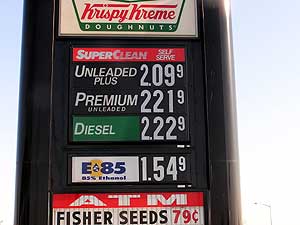
HUNTSVILLE, Alabama - Ford, General Motors and the president of the United States are all supporting ethanol as an alternative fuel source - which gives the renewable fuel some powerful friends.
But there's an 800-pound gorilla of an oil industry that has its own plans, which do not include going away. And gasoline has a 100-year head start.
Currently, there are some 170,000 gas stations in the United States, according to Fortune magazine, and fewer than 600 stations that sell E85, the 85 percent ethanol/15 percent gas mix that American automakers are now touting. There are no E85 stations now selling the fuel in Alabama.
Mark Hall, a Madison County extension agent and advocate of alternative fuels, summed up the dilemma faced by those who want to see ethanol move from a largely Midwestern fuel source to a U.S.-wide option.
"If the demand is there, the supply will be there," Hall said. "But how do you get demand without supply?"
Ethanol fuel is derived from corn, sugar cane and other natural materials. It has long been a darling of Midwest farmers and their homestate politicians and distrusted in other circles for its large government subsidies and production costs.
Dr. David Bransby, an Auburn University professor and recognized expert on energy and bioenergy, said there are a number of technologies the federal government has helped fund to the "pilot stage" which could help convert materials such as Alabama wood to fuel. But Bransby said those approaches don't yet have enough support from government or private industry - leery of the size of the investment - to reach full commercial potential.
"I've been in Alabama nearly 20 years and for goodness sake, this country put people on the moon almost 40 years ago," Bransby said. "That's way more difficult than getting ethanol from biological material."
There is a quiet effort under way to build a 50 million-gallon a year, $80 million ethanol production facility in the Tennessee Valley. Dennis Bragg, a third-generation Madison County farmer, said the effort is still in the project development stage, but the private investors hope to break ground within a year.
"For years we've all said 'We need to become energy independent,' but not one dollar was spent towards it," Bragg said. "Now we're in an era where money and effort are being put towards doing that.
"We're at the stage of when Thomas Jefferson and our forefathers sat around and discussed things before independence."
The 95 operating ethanol plants in the United States, nearly all in the Midwest, produce about 3.5 billion gallons of ethanol a year, according to the Maryland-based Clean Fuels Development Coalition. An energy bill passed last year by Congress requires refiners to produce a growing percentage of renewable fuels annually, as part of the total U.S. fuel supply. For 2006, the federal mandate requires 4 billion gallons of renewable fuels and increases annually to 7.5 billion gallons by 2012.
Bragg said even at full production, 50 million gallons of ethanol a year would only represent about 2 percent of the gasoline consumed in Alabama annually.
Bragg said consumers should consider the alternative fuels question as an issue of independence and dollars staying within the United States, rather than only through price at the pump. He said U.S. dependency on foreign oil finds its way into areas such as negotiations with Iran, and the current consumer market position leaves the government with less ability to maneuver.
Jim Johnson, general manager of Bill Heard Chevrolet, said GM's push to raise consumer awareness of E85 vehicles and alternative fuels is the best news he's heard for the worldwide auto industry in "years and years.
2006 Chevrolet Impala / Monte Carlo w/FlexFuel 3.5L V6
Model Number: 1WB19
Engine: 3.5L LZE
Horsepower: (hp @ rpm) 210 @ 5800
Torque: (lb-ft @ rpm) 220 @ 2800
Fuel capacity (gallons) 17.5

"I think it's a matter of familiarity and access," Johnson said. "Face it, everybody's aware we need to do something about our environment. Initially, if we got 100 E85s, I don't think we'd sell out in a week. But the more people find out about it, no doubt in my mind that will happen."
Johnson likens it to the awareness about recycling, saying it's become such an obvious route to take that there's a stigma attached if you're not participating.
Extension agent Hall said it will come down to economics, to finding a distribution system that provides motorists with easy access to E85.
"Most gas stations have 3 grades, if they've got tanks; you could take the middle grade of gas out and make that pump E85, if they had the demand."
Full, Uncut Article Here: http://www.al.com/business/huntsvil...4560.xml&coll=1

<!-- / message -->
Automakers sign on, but more use will take time, cash, familiarity
Sunday, February 19, 2006
By BRIAN LAWSON
The Huntsville Times
http://www.al.com/business/huntsvilletimes
HUNTSVILLE, Alabama - Ford, General Motors and the president of the United States are all supporting ethanol as an alternative fuel source - which gives the renewable fuel some powerful friends.
But there's an 800-pound gorilla of an oil industry that has its own plans, which do not include going away. And gasoline has a 100-year head start.
Currently, there are some 170,000 gas stations in the United States, according to Fortune magazine, and fewer than 600 stations that sell E85, the 85 percent ethanol/15 percent gas mix that American automakers are now touting. There are no E85 stations now selling the fuel in Alabama.
Mark Hall, a Madison County extension agent and advocate of alternative fuels, summed up the dilemma faced by those who want to see ethanol move from a largely Midwestern fuel source to a U.S.-wide option.
"If the demand is there, the supply will be there," Hall said. "But how do you get demand without supply?"
Ethanol fuel is derived from corn, sugar cane and other natural materials. It has long been a darling of Midwest farmers and their homestate politicians and distrusted in other circles for its large government subsidies and production costs.
Dr. David Bransby, an Auburn University professor and recognized expert on energy and bioenergy, said there are a number of technologies the federal government has helped fund to the "pilot stage" which could help convert materials such as Alabama wood to fuel. But Bransby said those approaches don't yet have enough support from government or private industry - leery of the size of the investment - to reach full commercial potential.
"I've been in Alabama nearly 20 years and for goodness sake, this country put people on the moon almost 40 years ago," Bransby said. "That's way more difficult than getting ethanol from biological material."
There is a quiet effort under way to build a 50 million-gallon a year, $80 million ethanol production facility in the Tennessee Valley. Dennis Bragg, a third-generation Madison County farmer, said the effort is still in the project development stage, but the private investors hope to break ground within a year.
"For years we've all said 'We need to become energy independent,' but not one dollar was spent towards it," Bragg said. "Now we're in an era where money and effort are being put towards doing that.
"We're at the stage of when Thomas Jefferson and our forefathers sat around and discussed things before independence."
The 95 operating ethanol plants in the United States, nearly all in the Midwest, produce about 3.5 billion gallons of ethanol a year, according to the Maryland-based Clean Fuels Development Coalition. An energy bill passed last year by Congress requires refiners to produce a growing percentage of renewable fuels annually, as part of the total U.S. fuel supply. For 2006, the federal mandate requires 4 billion gallons of renewable fuels and increases annually to 7.5 billion gallons by 2012.
Bragg said even at full production, 50 million gallons of ethanol a year would only represent about 2 percent of the gasoline consumed in Alabama annually.
Bragg said consumers should consider the alternative fuels question as an issue of independence and dollars staying within the United States, rather than only through price at the pump. He said U.S. dependency on foreign oil finds its way into areas such as negotiations with Iran, and the current consumer market position leaves the government with less ability to maneuver.
Jim Johnson, general manager of Bill Heard Chevrolet, said GM's push to raise consumer awareness of E85 vehicles and alternative fuels is the best news he's heard for the worldwide auto industry in "years and years.
2006 Chevrolet Impala / Monte Carlo w/FlexFuel 3.5L V6
Model Number: 1WB19
Engine: 3.5L LZE
Horsepower: (hp @ rpm) 210 @ 5800
Torque: (lb-ft @ rpm) 220 @ 2800
Fuel capacity (gallons) 17.5
"I think it's a matter of familiarity and access," Johnson said. "Face it, everybody's aware we need to do something about our environment. Initially, if we got 100 E85s, I don't think we'd sell out in a week. But the more people find out about it, no doubt in my mind that will happen."
Johnson likens it to the awareness about recycling, saying it's become such an obvious route to take that there's a stigma attached if you're not participating.
Extension agent Hall said it will come down to economics, to finding a distribution system that provides motorists with easy access to E85.
"Most gas stations have 3 grades, if they've got tanks; you could take the middle grade of gas out and make that pump E85, if they had the demand."
Full, Uncut Article Here: http://www.al.com/business/huntsvil...4560.xml&coll=1
<!-- / message -->
Last edited:


