Anybody good with electronics? How about an adjustable PWM delay circuit?

:
2008 Mazda5 Touring
I need a circuit that will delay a PWM signal already present. Time or phase shift it backwards somehow by 1-10 seconds. I can build circuits, just not design them. What it's for is a surprise if I get it working. Thanks.

 
Do you just want a circuit to pass/siwtch the PWM signal through once it has detected a PWM signal after 1-10 seconds? Or does the circuit needs to store the PWM signal wait 1-10 seconds and then re-sent it? The circuit for the first scenario is easy and can be done with a 555 timer some capacitors, resistors and a relay. The second scenario with require a micro-controller to store the wave form and resent it.
 
I think more of the latter. It needs to intercept the signal and send it delayed by what time I calibrate it to. The PWM signal is always present, but the microcontroller would only modify the signal when I need it to, and when turned off, would allow the original signal to continue as normal.
 
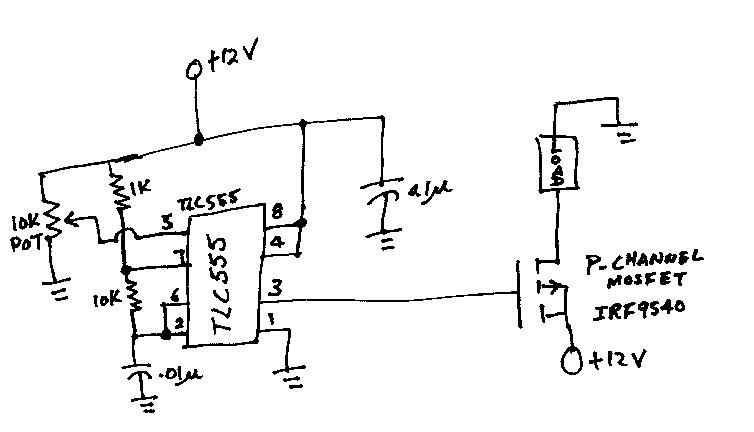
Here is a block diagram of what I think you are asking. You can use a SPDT relay to switch between the original and modified PWM signal. I do not know what you are trying to control but if it is just lights then I already have used a PWM circuit as a dimmer for the dash lights on my 78 Spitfire. The only thing missing is the delay circuit to control the relay.


svt9pj.jpg


dim.jpg
 
Delay circuit to control the relay? Is this diagram of a PWM circuit? What is the load in this situation, the dash lights?

OK, here's what I'm trying to accomplish. Upon setting the cruise control, the circuit would intercept the VSS signal (0-5v PWM) and delay it's input to the PCM. This, I'm hoping, would let me to adjust the time delay backwards just enought to allow greater speed fluctuations. ie, make the cruise target let precise, and give the effect of a constant throttle cruise control. Here's some pages from the service manual pertaining to the VSS.

View attachment Vehicle Speed Sensor (VSS).pdf
 
Another solution (though potentially dangerous), would be to intercept the 0-5v signals from the accelerator pedal and mimic this with a circuit. Problem is I can't find any information about the pedal in the service manual (probably because the '05-'06 weren't cableless?) and electronic pedals have a dual rising and falling voltage at the same time as failsafe and error checking. If you think this method would be easier to accomplish, I can pull the pedal and take some readings across it's terminals.
 
Another solution (though potentially dangerous), would be to intercept the 0-5v signals from the accelerator pedal and mimic this with a circuit. Problem is I can't find any information about the pedal in the service manual (probably because the '05-'06 weren't cableless?) and electronic pedals have a dual rising and falling voltage at the same time as failsafe and error checking. If you think this method would be easier to accomplish, I can pull the pedal and take some readings across it's terminals.

I have the (paper bound) Workshop manual for the 2006GT. There is not much mention about the details of the throttle by wire. It does have the related CEL codes and 'troubleshooting' steps which simply is a 'swap pedal assembly' kind. I did not order the Wiring diagram though.

But I have a document I got before about throttle by wire tuning.. from this site:
might be worth exploring. Maybe all that is needed is to buy the product.


http://www.cobbtuning.com/
http://www.accessecu.com/support/docs/tuningguide/AccessTUNER_HelpFile_MAZDASPEED.pdf
 
Last edited:
The information is interesting, but it all looks geared towards power inreases for forced induction vehicles. I definitely don't want to purchase a $600 device for a $20 feature...
 
Hi Flcrusing, another approach is to modify the connection to the throttle control motor. I could not find any information on the motor that controls the throttle, so I am making some assumptions. I assume the motor that operates the throttle is being driving via some PWM signal generated by the ECM. One way to slow the responds of the throttle control motor is to place an capacitor across the motor input. The capacitor will slow the change in the PWM signal by causing the PWM signal to take longer to reach its peak value. This capacitor will work if the motor is driven by an analog signal by delaying it from reaching its final value.

However, the correct value for the capacitor depends on the frequency of the PWM signal and the power requirement of the motor. So, in theory you can switch that capacitor in when you turn on the cruse control via a relay and when the cruse is off the capacitor is taken out of the circuit. I think this is the safest approach, if the capacitor fail either by shorting which will cause the car to stall or become an open circuit which in this case the car will responds like stock.

PS: Just thought of a potential problem if the capacitor shorts that might blow the fuse. So a fuse in series with the capacitor might solve this problem, but you will have to do some measurements to determine the value of the fuse.
 
How do I test the TB for the PWM signal and power like you describe? All I own is a digital multi-meter. The VSS test (attachment above) lists the use of an oscilloscope, I'd image that's needed for this too? What if the motor is a stepper?
 
I had not thought about the motor being a stepper. There is a easy way to see if the motor is just a DC or stepper, a stepper will require two wires per pole and I think normally they would be bi-polar and requires 4 wires to drive it properly. A DC motor will only have 2 wires.

The quick way to test the how much power a motor might use is to measure the resistance on it windings. Just use a DMM to measure the resistance then use ohms law (V=IR or I=V/R). The "V" is the voltage (I would use worst case of 14.6V), "R" is the resistance you measured and "I" is the current drawn at stall which is the worst case and is it also the current needed to get the motor to start moving. This will give you an good idea as to what fuses to use.

If it is a stepper, then things will be more complicated because it is the frequency that determines how fast the motor turns. So in this case you can just use a timer circuit to block the signals from getting to the motor. I assume the car's ECU will continue to send the signal to the motor until the throttle position sensor or the VSS reaches an satisfied value.

However, for now I think you should just determine what kind of motor it is. If it is a DC motor you can just try different value capacitors to see if it will affect the throttle responds,. You will most likely be using electrolytic capacitor, just have to watch for the polarity on them + goes to + and - goes to ground or -. There is probably a way to calculate the correct value of capacitor, but I do not know that off the top of my head, it will take same research for me.

Thats all for now.
 
Good info. I'll do some investigating on the t/b and get back to you. Not sure when that will be, as the weather forecast is rain until the weekend, but then one of my kids has a b-day Saturday. Please bare with me as you make this seem promising.
 
Good info. I'll do some investigating on the t/b and get back to you. Not sure when that will be, as the weather forecast is rain until the weekend, but then one of my kids has a b-day Saturday. Please bare with me as you make this seem promising.

Is okay, it is -17C(1F) and expecting 30+cm(12+inches) of snow in the next couple of days. We will not have above freezing temperature for at least another couple of months.
 
Is okay, it is -17C(1F) and expecting 30+cm(12+inches) of snow in the next couple of days. We will not have above freezing temperature for at least another couple of months.

Just be aware that the program in the computer has 'saved' some constants. A table of reference values that it uses to compare results during 'diagnostic' routine. For example, if a 'command' has been sent to the throttle actuator motor to rotate the 'butterfly', it is expecting 'normal' response from the throttle position sensor.

I will check the cel codes related to the throttle by wire subsystem when I get home. Usually the error codes gives hints as to how the thing works.
 
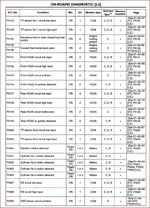
CEL related to the throttle by wire

I scanned the pages that had the codes for the throttle by wire for 2006 GT.

As you can see it has quite a lot of checking with regards to the the pedal position, throttle actuator, and throttle position sensor readings. Although it does not have yet the 'brake override' feature (avail. in newer models to eliminate possibility of unintended acceleration).

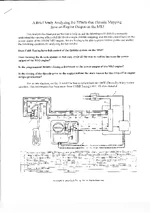
I included a page I once got from the internet showing the throttle by wire block diagram.

Let me know if you need the page for a particular CEL.
 

Attachments

  • tps1tps2.webp
    tps1tps2.webp
    74.4 KB · Views: 216
  • throttleCEL.webp
    throttleCEL.webp
    63 KB · Views: 217
  • tpsdwg.webp
    tpsdwg.webp
    603.5 KB · Views: 465
Last edited:
Thanks skyhawk. This definitely indicates a 12v stepper motor for the throttle. I still haven't gotten a chance to investigate, but hopefully the harness for the TPS's and throttle motor aren't together, that'd just be too easy.

Do you have the pages that correlate to the 'P' trouble codes? Section 01-02-##.
 
Davebert, thanks for your insight, but I've decided to not pursue this (as you've probably figured out by now) as the returns don't seems like they'll exceed the time/effort. If there were a simple way of 'holding' the voltage signal from the gas pedal by pushing a button, that may be a better solution. Or even a dial to turn to achieve the correct voltage. But with the ecu monitoring the t/b system like this, I can foresee the headache of fighting a CEL the other method will probably cause.
 
At the ecomodder website, they discuss doing things like this to your cruise control to improve MPG. It's not Mazda specific, but may offer insight.
LINK
LINK
 
ecomodder was actually where I got inspired. None of the information was conclusive besides installing an aftermarket cruise system (won't do) or throttle lever (won't work because of our e-throttle). The VSS mod seemed like the best approach, but I don't have access to test equipment to know where to even start. The constant throttle cruise by mimicking the e-pedal would be easiest to work with, but the feedback system would probably complicate it too much again. It's just too bad the tolerance and threshold can't be customized by accessing the PCM.
 

New Threads and Articles

Back