
Grounding Cylinder Head Test Results (2024 CX-5 Turbo)

Here is the road test with and without grounds from Post 109.

Car was on CC, same speed, same road, same day. Tests done back to back. This road test combines a few steep grades and level stretches. This is 11 data points that easily lined up with each other. One could run a test for an hour and average the two and much more. I'm not inclined to make a research project for a modification I've done for over a hundred cars.

This graft is % engine load vs time. If the car will run with LESS engine load over the same course it is more efficient.

Going up the grades the grounded engine shined vs steady state on flat or down grades. Accelerating it does even better, per the WOT, dyno tests. The CX 5 seems to be difficult to chassis dyno so I'm not motivated to dyno test.

This in NOT a home run, break through mod. It's cheap and save gas year after year or delivers about 10 crankshaft HP. I put ground on our new 2024 the evening we brought it home to lower operating costs.

Yellow line, no grounds, red grounds.
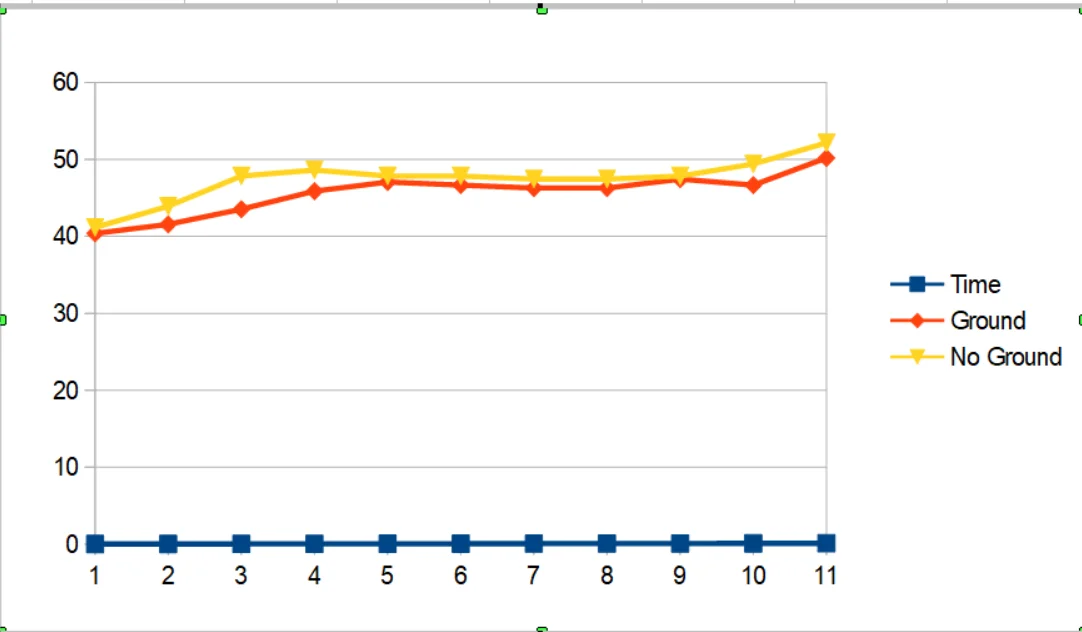
Mazda ground graph.webp
 
Last edited:
Here is the road test with and without grounds from Post 129.

Car was on CC, same speed, same road, same day. Tests done back to back. This road test combines a few steep grades and level stretches. This is 11 data points that easily lined up with each other. One could run a test for an hour and average the two and much more. I'm not inclined to make a research project for a modification I've done for over a hundred cars.

This graft is % engine load vs time. If the car will run with LESS engine load over the same course it is more efficient.

Going up the grades the grounded engine shined vs steady state on flat or down grades. Accelerating it does even better, per the WOT, dyno tests. The CX 5 seems to be difficult to chassis dyno so I'm not motivated to dyno test.

This in NOT a home run, break through mod. It's cheap and save gas year after year or delivers about 10 crankshaft HP.

Yellow line, no grounds, red grounds.View attachment 383015
What is the vertical axis?
 
"Extra" was probably poor wording on my part. The voltage drop in the ground lead reduces power at the device. A 12.5V system with 2.5V dropped in the ground lead leaves only 10V at the device. While it may be designed to operate at < 12.5V, it is not optimal. We called it 'ground lifting' when the voltage drop in the ground path become significant.

Injectors, solenoids, and electric clutches have high inrush currents when activated. in addition to the resistance in the ground path, there is also inductance which causes even higher voltage drops during these spikes. The heavier ground leads also reduce the inductance.
Exactly! Inrush is very important to fire the coils and injectors when the ECU commands.

Say we are traveling at 60 MPH in 5th gear, each pair of coils and injectors fire 17.5 times per SECOND. The engine is firing a pair, coil and injector, 70 Xs per second or 57 milliseconds.

The load on the system is much higher than when we test at idle. The coils have to recharge and fire. They have 3.5 ms to charge and 50 ms to cool before firing again. 17.5 times a second, 1,050 times per minute or 63,000 times per hour. Or the system is firing ALL of the coils and injectors 252,000 times per hour. At 80 MPH they fire a 336,168 times per minute.

This is anything but a steady state load. The coils and injectors fire from a ground signal from the ecu. The ground circuit is the critical electrical path....

It's critical on our daily drives as my race engine. FWIW, my race engine fires 4 times more often at 8000 rpm, (16) 40,000 volt coils. We wouldn't run large grounds the length of the car to the battery and ground the coils to the heads if it didn't make it work better. We have proven that running a high output ignition system adds more than 40 HP burning methanol fuel.

Not about the above, but another post but still relevant..
I LOVE the age old argument, IF it helps then Mazda would have used larger and more grounding cables. Well what about the other areas Mazda missed?

I proved that Mazda undersized the air filter box inlet on the Turbos. I posted how I proved the air box was starving the engine when under a load. I fixed it for about $75. Folks had the same argument about the inlet filter box TOO...

I added a turning vane in the obvious restrictive air intake transition on the turbos. Anyone with a little airflow knowledge agrees the transition is restrictive. I improved the flow and posted. Mostly ignored like the inlet air box mod. OK...

SO, don't ground your ride and be happy. Or push yourself away from the keyboard and find your hood latch and learn how to turn a wrench and test for yourself. Prove me wrong, I'm all about getting it right!

I'm offering simple, proven modifications that will impact the bottom line for thousands of miles.

I've already done it and proved it. Take it or leave it.
 
So the good news is mpg is no worse.. bad news is doesn’t seem any better. First fill up was driving in Montana including passes speeds 80mph and some faster. I have done this drive many times and it is what i normally get
IMG_0870.webp
IMG_0871.webp
 
486 miles 16.5 gallons so yesterday didn’t see any improvement maybe over the next few days i will😂
 

Attachments

  • IMG_0906.webp
    IMG_0906.webp
    34.9 KB · Views: 7
That's pretty conclusive evidence you will not get better fuel mileage.

Any chance you can disconnect the grounds for the remainder of the trip?

I'll carry what I need to disconnect the grounds on the fenders on our trip this summer. I will be a few weeks. I'll report the numbers, good or not so good...
 
Back