No, the sensor does not use the rotor for anything. It uses a gear behind the hub. The teeth of the gear passes over the sensor. You can see it behind the hub and in front of the dust shield. There's not much that can happen to a sensor, it is a passive device and unless it got physically damaged by something or maybe the wiring is frayed or cut. Other than that, it is most likely just dirty. The hardest part about checking the rear sensors is removing all the panels from the trunk, on a hatchback anyway. Use my little how-to that I mentioned above. It's easy.

You are using an out of date browser. It may not display this or other websites correctly.
You should upgrade or use an alternative browser.
You should upgrade or use an alternative browser.
ABS and brake warning lights on... but after a break-in
- Thread starter mark2000
- Start date
mark2000 - there's definitely no need to pay the dealer $500 to do the job--that's usurious! Here are some recommendations:
A. If you want the appropriate part of the factory shop manual, send me a PM with your e-mail address and I'll send it to you. It has quite a bit on diagnosis. The codes your car is showing indicate the ABS control module isn't getting a reading from the RR sensor at all.
You might want to check the clearance between the sensor and rotor--it should be 0.3-1.1mm. Not sure how this would get out of spec, but it would definitely cause a malfunction.
Make sure the rotor (the one with the teeth that gets read by the ABS sensor, not the rotor the pads clamp on) is clean--if it has any magnetic pieces stuck to it, it could cause a malfunction.
To access the ABS sensor harness plug, you'll have to remove the sidetrim in the trunk of the P5. The resistance across the ABS sensor should be 1.3-1.7kilohm.
When the rotor spins, the voltage should oscillate from 0.25-1.2V (AC). If you have an o-scope, you can use it to look for a sinusoidal curve whose frequency increases with wheel rotational speed.
B. If it turns out that the RR ABS sensor needs replacement, I would start by checking e-bay for the part or posting a WTB here. You can also source from a local junkyard since I think all P5's had ABS.
You can also just buy new. Consider onlinemazdaparts.com (Montgomery Mazda, an approved vendor here with good discounts off MSRP)--the RR sensor is US$85.50+fair shipping cost. Also, MSRP is US$109.65. Not sure how cross-border shipping works, though, you might have to go with a local stealership.
Looks like you'll kill this problem for <US$100. Keep us posted!
A. If you want the appropriate part of the factory shop manual, send me a PM with your e-mail address and I'll send it to you. It has quite a bit on diagnosis. The codes your car is showing indicate the ABS control module isn't getting a reading from the RR sensor at all.
You might want to check the clearance between the sensor and rotor--it should be 0.3-1.1mm. Not sure how this would get out of spec, but it would definitely cause a malfunction.
Make sure the rotor (the one with the teeth that gets read by the ABS sensor, not the rotor the pads clamp on) is clean--if it has any magnetic pieces stuck to it, it could cause a malfunction.
To access the ABS sensor harness plug, you'll have to remove the sidetrim in the trunk of the P5. The resistance across the ABS sensor should be 1.3-1.7kilohm.
When the rotor spins, the voltage should oscillate from 0.25-1.2V (AC). If you have an o-scope, you can use it to look for a sinusoidal curve whose frequency increases with wheel rotational speed.
B. If it turns out that the RR ABS sensor needs replacement, I would start by checking e-bay for the part or posting a WTB here. You can also source from a local junkyard since I think all P5's had ABS.
You can also just buy new. Consider onlinemazdaparts.com (Montgomery Mazda, an approved vendor here with good discounts off MSRP)--the RR sensor is US$85.50+fair shipping cost. Also, MSRP is US$109.65. Not sure how cross-border shipping works, though, you might have to go with a local stealership.
Looks like you'll kill this problem for <US$100. Keep us posted!
Last edited:
Maxpower and PaulJP:
I got the multimeter and tested the sensors...to no successful conclusion. Can anyone shed light on this?
Step 1:
- Took off the necessary trim and exposed the sensor connector I needed to test - rear right.
- First reading got 1300 on the OHM scale.
- I then set the meter to 750 (see attached picture of my multimeter - its the orange setting on the top right). Jacked up the car and spun the wheel - no changes on the multimeter.
- Reversed the black/red in the sensor connector - no changes.
- Also tried it at the 200 setting - nothing.
- I reached back to where the sensor was and tried to fiddle around, hoping I might fix a loose connection, or clean off some dirt - I'm not sure what I was thinking but I wanted to get a reading, so I was doing whatever I could.
- At this point, frustrated, I didn't know what to make of it - the sensor was testing OK but giving me no voltage when spinning it?????
Step 2:
- For consistency and to see if the number I was getting made sense, I exposed the rear left sensor and tested it. 1300 OHMS on the dot. Good.
- Turned the multimeter to 750 in the VOLTS section, and rotated the wheel. No changes on the multimeter. Tried 200 - no changes.
- Flipped black/red wires - no readings on 200 or 750.
- At this point, I concluded I must not be using the meter properly (I've never used one before) and so I tried pretty much all the other red and orange settings on the device. Finally, the readings were fluctuating on most of the settings EXCEPT the 200/750 when I spun the wheel.
- With this in mind, I realized I should have tried all the other settings on the meter on the right sensor too - so I put everything back together and went to re-test the right sensor.
Step 3:
- Tested right sensor again. THIS time, I wasn't getting anything more than 170 on the OHM scale. WTF??????? Well, if the sensor wasn't broken before, it sure was now. I could not do a THING to coax it back into giving me 1300.
- For kaka and giggles, I tried to test voltage on all those other settings other than 200/750. Most of the time, when I got readings, they were things like "-0.02" and fluctuating to "-0.07".
- Totally lost at this point.
Totally lost at this point. Frustatedly, and with scrapes on my hands, I thank you guys for the input...
And PS: No I didn't get the wheel off, I tried again but forgot to bring my WD out, I'm going to spray it on overnight and try the bolts again. I'd like to see the sensor.
I got the multimeter and tested the sensors...to no successful conclusion. Can anyone shed light on this?
Step 1:
- Took off the necessary trim and exposed the sensor connector I needed to test - rear right.
- First reading got 1300 on the OHM scale.
- I then set the meter to 750 (see attached picture of my multimeter - its the orange setting on the top right). Jacked up the car and spun the wheel - no changes on the multimeter.
- Reversed the black/red in the sensor connector - no changes.
- Also tried it at the 200 setting - nothing.
- I reached back to where the sensor was and tried to fiddle around, hoping I might fix a loose connection, or clean off some dirt - I'm not sure what I was thinking but I wanted to get a reading, so I was doing whatever I could.
- At this point, frustrated, I didn't know what to make of it - the sensor was testing OK but giving me no voltage when spinning it?????
Step 2:
- For consistency and to see if the number I was getting made sense, I exposed the rear left sensor and tested it. 1300 OHMS on the dot. Good.
- Turned the multimeter to 750 in the VOLTS section, and rotated the wheel. No changes on the multimeter. Tried 200 - no changes.
- Flipped black/red wires - no readings on 200 or 750.
- At this point, I concluded I must not be using the meter properly (I've never used one before) and so I tried pretty much all the other red and orange settings on the device. Finally, the readings were fluctuating on most of the settings EXCEPT the 200/750 when I spun the wheel.
- With this in mind, I realized I should have tried all the other settings on the meter on the right sensor too - so I put everything back together and went to re-test the right sensor.
Step 3:
- Tested right sensor again. THIS time, I wasn't getting anything more than 170 on the OHM scale. WTF??????? Well, if the sensor wasn't broken before, it sure was now. I could not do a THING to coax it back into giving me 1300.
- For kaka and giggles, I tried to test voltage on all those other settings other than 200/750. Most of the time, when I got readings, they were things like "-0.02" and fluctuating to "-0.07".
- Totally lost at this point.
Totally lost at this point. Frustatedly, and with scrapes on my hands, I thank you guys for the input...
And PS: No I didn't get the wheel off, I tried again but forgot to bring my WD out, I'm going to spray it on overnight and try the bolts again. I'd like to see the sensor.
Attachments
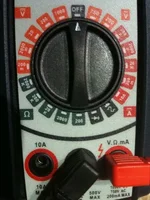
Seems like you did the right things. Couple notes:
A. Black always stays in the center hole. When measuring voltage and resistance, keep the red probe plugging into the right red hole.
B. The voltage range will be 0.25-1.25V = 250-1250mV alternating current (AC). This means you should choose the setting... well, doesn't seem like your voltmeter has just the right range for this. I'm not sure which setting is best, since 200V obviously lacks enough resolution, and the next highest (200mV on the right side) is too low. It's possible you won't be able to get a good voltage reading with this multimeter.
C. To get the bolts off, try stepping on the end of the wrench, using your body weight as force. If that doesn't work, you can try using a jack to apply force to the end of the wrench. Otherwise you can invest $30 in a good breaker bar and socket from Sears.
A. Black always stays in the center hole. When measuring voltage and resistance, keep the red probe plugging into the right red hole.
B. The voltage range will be 0.25-1.25V = 250-1250mV alternating current (AC). This means you should choose the setting... well, doesn't seem like your voltmeter has just the right range for this. I'm not sure which setting is best, since 200V obviously lacks enough resolution, and the next highest (200mV on the right side) is too low. It's possible you won't be able to get a good voltage reading with this multimeter.
C. To get the bolts off, try stepping on the end of the wrench, using your body weight as force. If that doesn't work, you can try using a jack to apply force to the end of the wrench. Otherwise you can invest $30 in a good breaker bar and socket from Sears.
I'm going to return the meter and buy another one that will work with this application.Seems like you did the right things. Couple notes:
B. The voltage range will be 0.25-1.25V = 250-1250mV alternating current (AC). This means you should choose the setting... well, doesn't seem like your voltmeter has just the right range for this. I'm not sure which setting is best, since 200V obviously lacks enough resolution, and the next highest (200mV on the right side) is too low. It's possible you won't be able to get a good voltage reading with this multimeter.
However what do you say to the fact that on Step 3, the right rear sensor wasn't showing the right OHMS any more. Do you think it's broken? Could I have busted it somehow by applying the wrong tests to it, or poking around too much in there with my hands? Very strange that it showed 1300 at first and then only 170 later.
As for the tire, I did try stepping on the wrench tonight, but that didn't work either. I am letting WD40 soak into the lug nut over night and see if that helps. [Yes I know WD40 isn't the best thing to use but it's all I have in the house right now]
If the sensor was already on the fritz (say a shredded wire), then fiddling with it could finish it off. All the better for diagnosis. That most likely wouldn't happen to a healthy sensor, unless you were really rough.
It's a bit odd the resistance dropped, but still the sensor is out of spec. A post-mortem could explain why.
If you have two wrenches, try using one on the wheel, and the other to rotate the jack, with the jack applying the force at the far end of the wrench. I've had luck with this to remove stubborn lug nuts. WD40 might help, but what will definitely work is torque.
It's a bit odd the resistance dropped, but still the sensor is out of spec. A post-mortem could explain why.
If you have two wrenches, try using one on the wheel, and the other to rotate the jack, with the jack applying the force at the far end of the wrench. I've had luck with this to remove stubborn lug nuts. WD40 might help, but what will definitely work is torque.
Exactly - the sensor is now out of spec and that much is now confirmed, so it has to be replaced no matter what. The "frayed wire" theory is exactly what I'm thinking. I park outside and the right wheels are always facing the road and traffic, not the curb. I would not be surprised if all the heavy rain we got this year, caused cars driving down that street to splash the tire area enough to cause damage.
Also I don't understand what you mean about using one wrench with another. I think I will just end up having to get a big bar from the store, but in case I can do it your way, please explain.
Other than that, the WD might have results in the morning, and I could finally take off the tire to see what is going on behind there.
Also I don't understand what you mean about using one wrench with another. I think I will just end up having to get a big bar from the store, but in case I can do it your way, please explain.
Other than that, the WD might have results in the morning, and I could finally take off the tire to see what is going on behind there.
I have the 2003 P5 hatchback with the factory wheels.
They are the 5 spoke kind of grey plastic covered rims.
I use a 21mm black impact deep socket with an air gun on the wheels.
I am not sure what the American equivalency is.
And one of them is anti-theft per wheel, at least on my car and I didn't put them on.
Either they came from the factory like that, or from the person who owned the car before me.
Yours seems to be very tough to get off. I would be concerned about breaking the studs.
Once you do get them off however, I always put a dab of grease on the studs before putting the nuts back on.
Do you know anyone with air tools that could try to get them off ?
They are the 5 spoke kind of grey plastic covered rims.
I use a 21mm black impact deep socket with an air gun on the wheels.
I am not sure what the American equivalency is.
And one of them is anti-theft per wheel, at least on my car and I didn't put them on.
Either they came from the factory like that, or from the person who owned the car before me.
Yours seems to be very tough to get off. I would be concerned about breaking the studs.
Once you do get them off however, I always put a dab of grease on the studs before putting the nuts back on.
Do you know anyone with air tools that could try to get them off ?
Last edited:
Well, I am in Canada. My rims are the alloy, aren't all P5s?I have the 2003 P5 hatchback with the factory wheels.
They are the 5 spoke kind of grey plastic covered rims.
I use a 21mm black impact deep socket with an air gun on the wheels.
I am not sure what the American equivalency is.
Do you know anyone with air tools that could try to get them off ?
I have heard 21mm and 19mm being the spec, so I am not sure what I have.
Edit: It just occurred to me. Could the nuts I am taking off be part of a wheel cover? Do alloy rims usually have a cover on top of the actual bolts? Now maybe it makes sense why the tire wrench has a little thin flat part on the other end............. Here is a picture of pretty much the model I have:
http://www.finishlinewheels.com/prodimg/ALY64857U.jpg
Last edited:
Once you do get them off however, I always put a dab of grease on the studs before putting the nuts back on.
While it probably doesn't make much of a difference, I don't advise putting anything on the studs when putting the nuts back on. The torque specification is designed for dry lug nuts. Lubricating the lugnuts, for instance, could make them come off a bit too easily (not good--don't ask me how I know).
Making sure the studs are clean and tightening to specification should be all it takes to remove the wheels easily next time.
Well your rims look like my rims.
21mm should work.
I find it hard to believe that none of your bolts will come off.
Have you tried any of the other wheels to see if it at least one will come off ?
As for putting grease on the studs. That was something someone told me a long time ago and I just kept doing it. Perhaps a wire brush at the end of a drill would make better sense. I think I might try that from now on.
21mm should work.
I find it hard to believe that none of your bolts will come off.
Have you tried any of the other wheels to see if it at least one will come off ?
As for putting grease on the studs. That was something someone told me a long time ago and I just kept doing it. Perhaps a wire brush at the end of a drill would make better sense. I think I might try that from now on.
Of you go to online mazda parts (http://www.trademotion.com/partloca...tege&year=2002&catalogid=1&displayCatalogid=0), the sensor for the disc brakes is $85, while the drum brake saves you almost $40 at $48. Either way, lots cheaper than what you were quoted.
Try finding a local forum or post up where you live, someone will likely be willing to give you a hand replacing the part.
Try finding a local forum or post up where you live, someone will likely be willing to give you a hand replacing the part.
Problem fixed itself
Problem seems to have fixed itself. I tried to clear the codes today and it worked. The lights went off, and I tested ABS - which didn't work, and then the lights came back on.
So, I reset them again, and tested ABS on a gravel road, it worked fine, three times. Drove home and lights still haven't gone on. Parked, started the car and drove again a little later - still looking good, no lights.
I finally got the cheater bar anyway, so I could visually inspect the sensor wires. So I got four bolts off, one won't come off. Is there a tecnique or trick to this, can I drive back and forth a couple of feet with four of the five bolts off, to loosen up the final bolt? Or should I jack it up and jerk the tire lightly, to loosen the final bolt?
I hate and love when problems fix themselves... because you never know when it will return. I also hope that the problem isn't with the ABS computer itself, or I'm done for. Anyone experienced this intermittent sort of issue with the sensors before?
Problem seems to have fixed itself. I tried to clear the codes today and it worked. The lights went off, and I tested ABS - which didn't work, and then the lights came back on.
So, I reset them again, and tested ABS on a gravel road, it worked fine, three times. Drove home and lights still haven't gone on. Parked, started the car and drove again a little later - still looking good, no lights.
I finally got the cheater bar anyway, so I could visually inspect the sensor wires. So I got four bolts off, one won't come off. Is there a tecnique or trick to this, can I drive back and forth a couple of feet with four of the five bolts off, to loosen up the final bolt? Or should I jack it up and jerk the tire lightly, to loosen the final bolt?
I hate and love when problems fix themselves... because you never know when it will return. I also hope that the problem isn't with the ABS computer itself, or I'm done for. Anyone experienced this intermittent sort of issue with the sensors before?
New Posts and Comments


- Replies
- 291
- Views
- 218K


- Replies
- 2
- Views
- 99

- Replies
- 2
- Views
- 45