The tire pressure on the door jam is intended to enable the prescribed tires to support the weight of the vehicle. If you use a lower pressure you will probably not have the ideal tire contact patch and you will have more sidewall flex.
Sidewall flex can lead to overheating and blowouts under certain conditions and the energy used in the tire flex decreases your fuel economy. It's a little like driving in sand if the tires are too low.
If you experiment with different sized tires you might need to adjust the pressure to have enough air to support the weight you are carrying.
Some people apparently like to use the maximum rated pressure noted on the tire (which can support the maximum weight) but this could lead to a rough ride.
Here's a web site with lot's of information on tires, etc...
G91A are 100H but I couldn't find that.
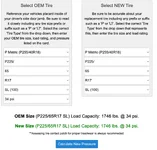
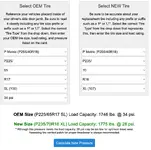
I put in P225/65/R17 and got 100SL. It sayds optimal load is 34 PSI. But I thought you could lower psi by 10% of OEM so 3.4 but I did 4.
I guess air back up to 34? What are the consequences? I dislike the harder ride
On the other hand I calculated snow tires at 235/70R16 with 107XL.
The Michelin X-Ice Snow SUV is 106T for reference and I was told the optimal is 28 PSI?
I believe Winter tires as a rule of thumb should be set 3-4 PSI higher than the placard so 38 PSI.
I still got 28 PSI.
G91A are 100H but I couldn't find that.
I put in P225/65/R17 and got 100SL. It sayds optimal load is 34 PSI. But I thought you could lower psi by 10% of OEM so 3.4 but I did 4.
I guess air back up to 34? What are the consequences? I dislike the harder ride
On the other hand I calculated snow tires at 235/70R16 with 107XL.
The Michelin X-Ice Snow SUV is 106T for reference and I was told the optimal is 28 PSI?
Yeah, I don't know about the preferences the app has for the load, but there are other tire pressure calculators out there as well. Maybe try a few of the other ones to see how they compare.
I find that the handling of my vehicle really is not satisfactory at all when set to anything less than the recommended pressure. I would rather stick with sharp handling at a sacrifice of comfort over certain sections of rough roads.
Assuming that your road conditions may be worse, you should speak to the tire manufacturer directly to determine what tire pressure is acceptable for your specific vehicle.
I am now 100% convinced that the source of the ride quality in these cars is the shock valving. IMO it's fine when stock but when lowering and/or upsizing wheels you'll notice it a lot more. I'm doing a lot of research into alternatives. Koni SA are out, so I'm looking into custom adjustable coilovers. It's not money I really want to spend but I'm intrigued by some of the possibilities.
I find that the handling of my vehicle really is not satisfactory at all when set to anything less than the recommended pressure. I would rather stick with sharp handling at a sacrifice of comfort over certain sections of rough roads.
Assuming that your road conditions may be worse, you should speak to the tire manufacturer directly to determine what tire pressure is acceptable for your specific vehicle.
I had Michelin X-Ice on my old Rav4. Hands down it was a great tire on Ice and snow under 10". I still have them. The downside of snow tires, even if there's plenty of thread on them, the tires tend to harden from age.
I am now 100% convinced that the source of the ride quality in these cars is the shock valving. IMO it's fine when stock but when lowering and/or upsizing wheels you'll notice it a lot more. I'm doing a lot of research into alternatives. Koni SA are out, so I'm looking into custom adjustable coilovers. It's not money I really want to spend but I'm intrigued by some of the possibilities.
On the other hand I calculated snow tires at 235/70R16 with 107XL.
The Michelin X-Ice Snow SUV is 106T for reference and I was told the optimal is 28 PSI?
I believe Winter tires as a rule of thumb should be set 3-4 PSI higher than the placard so 38 PSI.
I still got 28 PSI.
The skinny tires on a racing bike are inflated to a high pressure (for efficiency), but those fat tires on the beach cruisers are much lower.
A big fat tire with higher pressure might be kind of 'bouncy'.
I like the tires on my CX5 which are the standard size 17" Continental LX25 and I like the 'nimble' feel but I guess they do transmit the road surface.
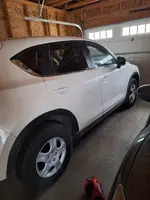
Purchased a 2024 CX-5 GS in Rhodium White. I love it
Based in Edmonton, AB Canada.
It's on Yokohama Geolandar G91 (P225/65/R17) tires. I feel the ride on Edmonton roads to be very rough and loud? The suv is my type - great size for family and needs. My test drive was brief and I loved the vehicle. The tires I heard are trash - loud noises from the road make into the cabin, stiff over smooth roads etc. I know Mazda is a sporty brand but wouldn't it be the case of tires making my car so harsh to drive?
What's a remedy for this, better tires? What do you recommend?
I am really surprised how long this thread has gone on, really. You cannot alter the design of a well designed suspension with tires. Oh you might get a softer ride by using tires with a very tall sidewall and keep them underinflated but today all tires are built to a standard for a specific application for a specific vehicle and that's what you should have. It's like trying to put an elongated bowl toilet seat on a regular type toilet - it just doesn't fit the application.
These are on Michelin X-Ice Snow SUV tires 106T (235/70R16) at 32.5 PSI.
This winter tire is a soft compound but surprisingly rides abit harsh vs the Yokohama Geolandar G91A 100H (225/65R17).
I was curious why this is. Shouldn't a thicker sidewall like the X-Ice Snow SUV be more cushy over bumps? Is it the load and speed index going from 100H to 106T which means a stiffer tread to compensate for heavier capacity?
Is it appropriate to power PSI to 30 but also winter is coming so I'll lose 1 PSI every month?
X-Ice Snow SUV tires made on 25th week of 2024 so fairly fresh.
I am now 100% convinced that the source of the ride quality in these cars is the shock valving. IMO it's fine when stock but when lowering and/or upsizing wheels you'll notice it a lot more. I'm doing a lot of research into alternatives. Koni SA are out, so I'm looking into custom adjustable coilovers. It's not money I really want to spend but I'm intrigued by some of the possibilities.
Definitely the shocks. The oem spring rates are comparably to other soft crossovers. After switching to coil overs with dampers set on soft, it's been way more livable even with stiffer springs.
Stock springs are actually 2.9K Front and 5.3K Rear. This is what I got from Corksport's analysis.
I'm using Ceika's comfort coilovers. Id recommend those but with 5k springs on the front instead of the 6k they recommend and with adjustable end links. 6k backs are fine. It's no luxury cruiser but more comfortable than stock while still being stiff. It got rid of the highway front hopping and feeling every crack in the road. If that's not enough, I switched the 19s to 18s that can run thicker tires at a slightly lower psi.
Best we can tell is stock for the AWD Turbo is 2.94/4.11 per AutoEXE. CS has different numbers but they seem a bit exaggerated to me so I'm not sure if they're accurate.
Stock springs are actually 2.9K Front and 5.3K Rear. This is what I got from Corksport's analysis.
I'm using Ceika's comfort coilovers. Id recommend those but with 5k springs on the front instead of the 6k they recommend and with adjustable end links. 6k backs are fine. It's no luxury cruiser but more comfortable than stock while still being stiff. It got rid of the highway front hopping and feeling every crack in the road. If that's not enough, I switched the 19s to 18s that can run thicker tires at a slightly lower psi.
This is even with the 19in stock wheels. Ive have had 18s on the stock suspension before with good tires, but the effect was hardly noticeable. Which is what led me down the coilover journey. Pic with 19s lowered and pic when I had 18s on stock suspension for profs
I have been talking with Ceika for a couple of weeks now and think I have my specs determined, except for one thing.
They offer helper springs, but they claim they work more like a dual rate spring which provides ride and handling benefits. Typically "helper" springs don't; they only help retain preload on the main spring so it doesn't come loose.