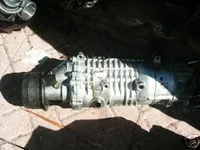
Mazda Milenia/Miata Supercharger performans map

7agzte

Member
:
Toyota sprinter trueno 7agzte 4wd
Who knows цhere it is possible to find turbo map on the compressor on the 2,3 engine?

It is necessary to know urgently !!!!!!!!!
 
There is no turbo map for the millenia or miata supercharger, because they aren't turbo's, so they operate completely differently.

What do you need it for?
 

Attachments

  • 2b2a_1.webp
    2b2a_1.webp
    17.4 KB · Views: 263
I need to know
- boost pressure on crankshaft rpm's
- boost pressure on chargershaft rpm's
- Power consumption of this compressor
 
I found the following at http://forums.mazdaworld.org/index.php?showtopic=8526

.....................

k, this information I'm supplying is not exactly the same as the SC found in the milly, but according to lysholm (yes, lysholm is a company all of its own):

QUOTE
The Compressor used in the Mazda was to some extent designed
at our sister company SRM. The compressor is a screw compressor
"Lysholm" type. The compressor received its final designed by
IHI in Japan, an is as efficient as any other screw compressor.
If you look at www.lysholm.se you can find information about
the efficiency of a normal generic lysholm compressor. The size
nearest to the compressor size in the Mazda is the LYS 1200.


So, these are specs for the LYS 1200 (alot of these were metric or other measures which I have converted to more familiar measures):

maximum screw speed: 15,000 rpm
maximum operating pressure ratio: 2.2 (this equates to 32.34 psi, or about 17.6 psi "boost" pressure)
displacement: 1.2 L/rev
maximum operating flow: approx. 600cfm at full pressure

For those of you who know about adiabatic and volumetric efficiency, or better yet want to read the compressor flow map for yourself, here it is:

http://www.opcon.se/www/files/lysholm/pdf/performance charts/diagram_lys1200ax.pdf


The lysholm site also has a few neat little animations showing a lysholm compressor at work. the main difference I've seen between lysholms and other screw-type compressors is the "screws" in a lysholm are lobed rather than simple screws; the male rotor has 3 lobes, the female has 5 lobes. the 2 rotors never come in physical contact with each other, rather they fit veeeerry well into each other. all lysholms have helical gearing for precise timing so the rotors never touch, and for quiet operation as well.

 
I also found this:
http://www.maddoldbugger.supanet.com/blower.html

The Miller Cycle, or type-KJ engine marks the first automotive application of both the Miller cycle and the Lysholm compressor. The main advantages to this design are power output and fuel economy. The engine produces a maximum of 210 bhp@5300 rpm, with a peak torque rating of 210 lb-ft@3500 rpm. The torque curve itself never drops below 182 lb-ft from 1700 - 8000 rpm. An outstanding achievment by any measure. Even more amazing is the fact that this power output comes from a 2254 cc engine with a very understressed 8.0:1 compression ratio. It would be fair to consider the engine as a "blown" engine, however, the application differs than a standard Roots blower. 2 plenum chambers feed 3 cylinders each with pressurized air. A Lysholm compressor is used because of it's low pulsation and therefor inherently quiter running. It was important to Mazda engineers that you feel the effects of the Miller cycle engine without hearing it. A helical gear train helps keep noise low, and the system as a whole runs very comfortably. Maximum male rotor speed is only 35,000 rpm, while the female rotor max's out at just 21,000 rpm. Even so, the effeciency of the Lysholm Compressor far surpasses that of a comparable Roots blower.


Does that answer your questions???
 
Back