
Intake manifold for protege?

bidi

Member
:
1999 Mazda Protege
I have a 99 Protege DX (1.6L)

and was wondering if there's a better intake manifold than my stock one
that bolts up to my engine head?

Would a MSP or Miata intake manifold bolt up? ...or one from a different year?

I'm looking to see if I can find one that flows better than my current one.
Mostly looking to improve my mpg, but gaining a bit of hp or torque would be nice too.
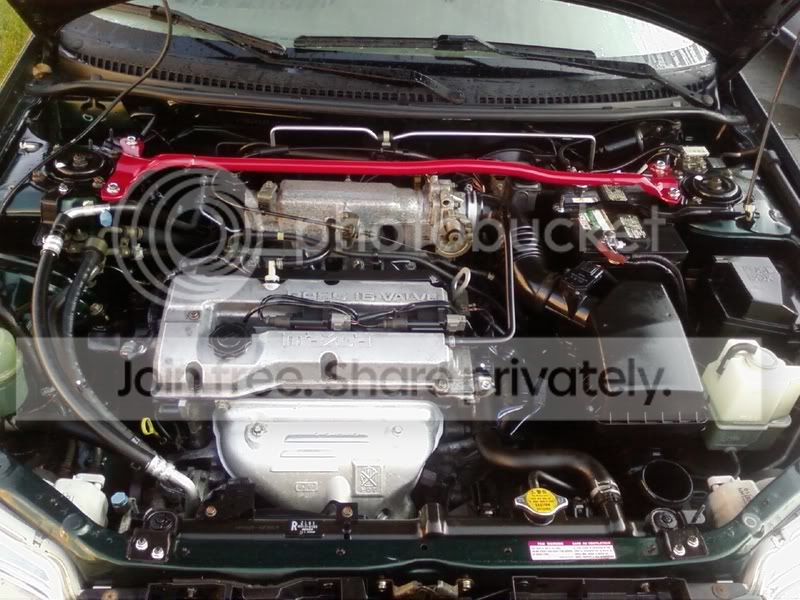
 
I'm sure you all know what a DX engine looks like, but here's a picture of my engine anyway.

Enginebay.jpg
 
The European 1.6 ZM intake manifold is better than the USDM ZM-DE manifold. It has VICS.
Only problem is that it'll be a little hard to get for ya and it will be pricey new.
So is it worthy changing it? A Cold Air Intake would be a better optiom imho.


ZM:
mazda_engine_zm.jpg


The EuroSpec ZM engine has VICS* (That's why the intake manifold looks different from the US ZM-DE).

*VICS (variable inertial charge system):
By setting the precise length of the inlet pipe to ensure an even blend of fuel vapour with air and optimising air pressure, maximum energy and perfect burn is delivered. To boost torque at higher speeds. Conceptually, it is like a variable valve timing system (but is not the same thing) in that it allows more air to be drawn in at speeds above 4750 rpm, thereby keeping the torque curve at a higher level rather than falling off.
 
Last edited:
The European 1.6 ZM intake manifold is better than the USDM ZM-DE manifold. It has VICS.
Only problem is that it'll be a little hard to get for ya and it will be pricey new.
So is it worthy changing it? A Cold Air Intake would be a better optiom imho.


ZM:
mazda_engine_zm.jpg


I have family in all over euroe... Germany, UK ect, ...maybe I'll ask if any of them can look it up.

Thanks.
 
The European 1.6 ZM intake manifold is better than the USDM ZM-DE manifold. It has VICS.
Only problem is that it'll be a little hard to get for ya and it will be pricey new.
So is it worthy changing it? A Cold Air Intake would be a better optiom imho.


ZM:
mazda_engine_zm.jpg

How about the JDM spec?
 
bidi, doesnt your intake manifold rub on the strut bar when you put it in reverse and rev?, wont it cut the bar?,

Normaly it would rub, but I shaved the top of the IM a little bit,
and shimmed the tie bar, so there's about a quarter of an inch gap
between the IM and the tie bar.
... it barely clears it when the eingine is moving (peep)


wow, that 1.5L VVT kicks ass.

Does the intake manifold from ZM engine use vacum to activate VICS,
or is the complicated electronic system with sensors and what not?

P.S.
I don't want ot use cool air, or any other aftermarket intake system... only factory parts.
Not to mention, even a short-ram intake tend to set off codes in thses little 1.6L engines.
 
Last edited:
VICS has an actuator (soleniod) that activates it, look at the link below to see how it works
http://www.youtube.com/watch?v=-r5W86DmvoE

When it "switches on" the engine is 'round 3800-3900rpm, this is the BP engine in the shot.

Here's an explanation of the VRIS system - http://www.geocities.com/mikey9t6/car_uvwxyz_vris.htm

Originally Posted by wfmartin's EPIX.com site
vrisplot.jpg
Most knowledgeable people would look at our intake manifold and wonder why any competent engine manufacturer would design an intake manifold that's so restrictive in design. What they don't know is the VRIS system.

VRIS stands for Variable Resonance Induction System. From a power standpoint, the VRIS switches between 3 different torque curves as the engine goes through the rev band. Each torque curve is optimized for a certain RPM range and that's where that particular curve is used.

Two valves open and close to determine the path of the air, which changes the torque curve. The diagram on the right illustrates this. Suppose you tied both valves open? Your torque curve would look like the purple one and would only be optimal between 4250 RPM and 6250 RPM. If you tied just the #1 valve open, you'd get the green curve, and if you tied them both shut, you'd get the blue one[SIZE=-1].

Common sense will tell you that the best place to switch curves is at their natural intersection point
of the curves[/SIZE]
[SIZE=-1]. This is what Mazda did when they designed the system. They took the average plots, found where they intersect, and programmed the VRIS to change at those points. Hence, we get the smoother, torquier dotted-red curve. The only real room for improvement here is that all engines are slightly different, and if you took the three plots for your engine, and found the intersection, it may be off by a few RPMs. Not enough to make a really difference unless your engine is precision tuned. Bear in mind that this only applies directly to torque.

Horsepower is not what the VRIS was designed for, but logic would have it that the effect on horsepower would be very similar. Some people have claimed actual HP gains from tying the valves open, but until someone comes up with three overlaid plots showing these gains, that will still be under argument.

And even if they do, the best modification is still to move the VRIS actuation points, not remove the whole system.
VRIS actually works by opening and closing valves to change the length and path of the air through the intake manifold. It does not allow more air through. It works similar to a trumpet. The valves open and close, changing the frequency of the air. In a trumpet, this changes the note that is produced.

The reason VRIS works is because air follows a natural path depending on its frequency. In most applications, this effect is small enough not to be of any concern or value. However, our intake manifold is designed to take advantage of this. Each torque curve from above has its peak because at that RPM range, the velocity and frequency of the air is tuned correctly so the air's natural path is straight down the intake runners.

Suppose the diagram at the left shows the air paths with both valves open. At about 6500 RPM, the air has its velocity and frequency matched to lead it straight into the intake runners. If we decrease the RPMs, the air travels at lower velocity and the curve from the resonant frequency is too sharp and the air stumbles against the wall of the manifold, making it harder for the engine to draw in the air. If we increase the RPMs, the same effect will occur, with the frequency not providing enough curve to over come the velocity and it misses on the other side of the runners.

In most other intake designs, the manifold is just a splitter where the air comes down and hits a split and gets broken into two streams: one for each cylinder. Our entire manifold is designed around VRIS. Without VRIS, our manifold would be a huge restriction and a big performance bottleneck.
[/SIZE]

Variable Resonance Induction System
What is VRIS
How to test your VRIS
VRIS in detail
 
Last edited:
i re-did the intake, using the simota intake that protephile sells, plus a bit of the old intake and an extra piece of pipe, and it works great.

and strange thing is , we're getting increased low end torque since the added piece of pipe is of a smaller diameter than the inlet
 
Last edited:
bidi, my advice to u is leave in the ram air ducting, no matter how little air gets in through it, it will help to cool your engine bay and help with increased hp at higher speeds,
 
Last edited:
you cant see it in the pic, but i replaced the stock exhaust manifold with the 4-2-1 from the zl-ve engine, so that also led to an increase in hp, have a HKS super dragger exhaust, and am using nology silver spark plugs...yeah, i know the engine is dirty, will clean it this weekend, and bidi, my advice to u is leave in the ram air ducting, no matter how little air gets in through it, it will help to cool your engine bay and help with increased hp at higher speeds,

I probably will put the ram air ducting back in... not so much for performance, but just because it's stock and looks clean.

Where did you put your catalytic converter if you went with a 4-2-1 exhaust manifold?
 
I see, well I have to keep it, because any car that's '96 or newer has to pass emissions, and if it doesn't license get's suspended.
 
what are you looking to get for it?

Do you have any dyno sheets to show any gains?

I live in US, so shipping along would probably by an arm and a leg.
 
Haven't seen anybody do it. Putting a ZM intake on a ZL or ZM-DE
or similar.

But I have a sheet of the Miata 1.8 NB
that compares open shutters vs. closed vics shutters.

0101scc_projmiata12_zoom.gif


Price will be about 140

shipping will be anywhere between
58(5-10kg) and 105(10-20kg).
Not sure how much it weighs.

Keep in mind you'll need some extra parts to make it all work like an rpm-activator.
 
I am interested in trying out the EDM ZM intake mani (with an RPM switch of course), but I am planning on doing a turbo install. I'm trying to figure out if this intake mani would help me/hurt me in the long run. It really has to do with how efficient this mani is compared to the stock mani both in a boosted environment. Anyone want to drop some knowledge here?
 
Back